Montreal housing situation a ‘crisis of unaffordability’
New TAL rent increase recommendation takes into account past three years of inflation
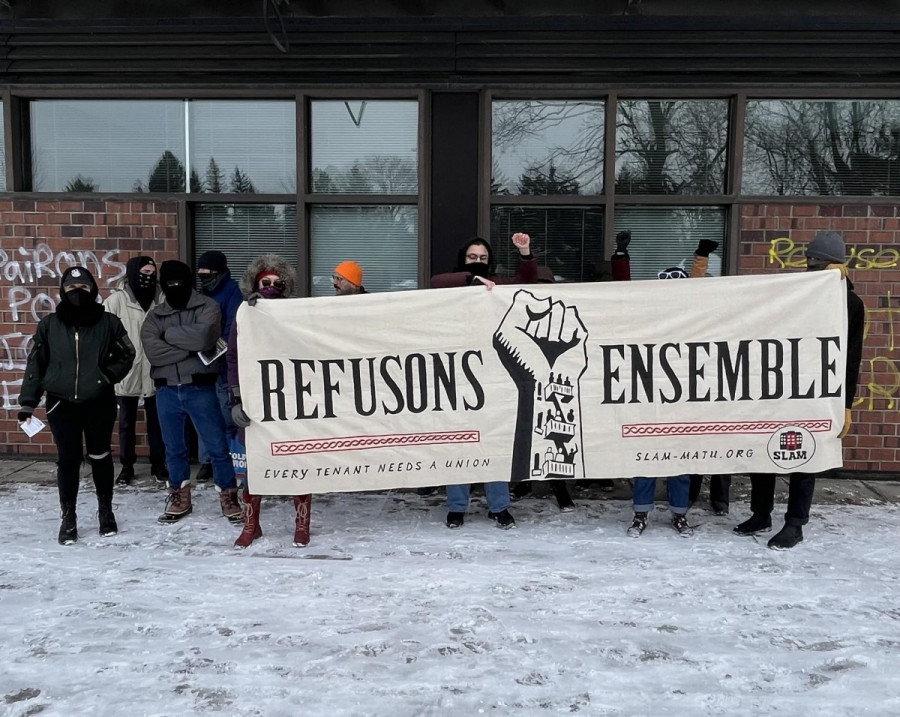
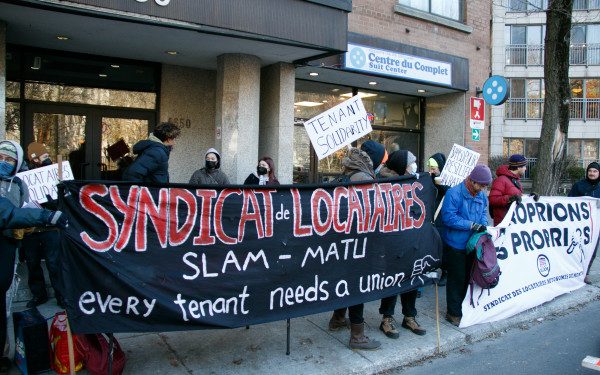
Just past noon on Jan. 19, a group of a dozen demonstrators gathered outside the office of the Tribunal administratif du logement (TAL) in Montreal’s Olympic Village.
Together, they held up a large banner that read, “Refuse together, every tenant needs a union.” Behind them, spraypainted on the building’s brick wall in bright yellow, was a straightforward message: “Fuck landlords.”
“We believe that housing should be distributed based on need and not financial means,” said a spokesperson for the Montreal Autonomous Tenants’ Union (MATU), the organization behind this surprise action.
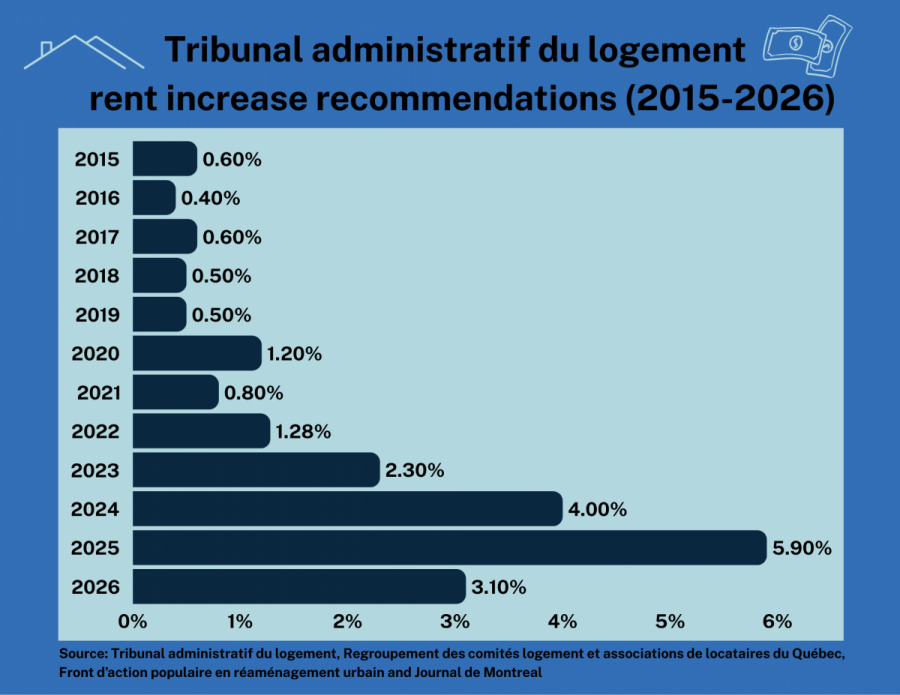
The last-minute demonstration was organized in response to the TAL’s recently implemented basic rent increase recommendation for 2026. The tribunal is recommending a 3.1 per cent rent hike for all Montreal apartments that have not undergone major renovations.
While this rent increase percentage is smaller than the 5.9 per cent increase from 2025, some tenants’ rights groups believe this year’s increase is still too high.
“It’s not exactly good news in the sense that 3 per cent is still fairly high,” said Steve Baird, a community organizer with the Regroupement des comités logement et associations de locataires du Québec (RCLALQ). RCLALQ is an advocacy group focused on the right to housing and tenant solidarity.
For years before the start of the COVID-19 pandemic, all of the TAL’s annual rent increase recommendations for basic apartments were under 1 per cent, Baird explained.
“Three is a lot compared to less than 1 per cent, so this is going to keep pushing rent up,” he said.
Baird added that the new calculation being used to determine the rent increase recommendation this year is a significant change from years prior. This year, the TAL is taking into account the past three years of inflation in its calculation, whereas in previous years, the calculation was based on the last year of inflation.
“Right now, inflation has just come down, and we’ve just paid really big rent increases for the inflation of last year and the year before,” Baird said. “Now that it’s finally come down, all of a sudden, [the TAL] has decided, ‘Well, let’s calculate the last three years [of inflation].’ That’s why it hasn’t come down that much; that’s why it’s still 3 per cent and not less than that.”
RCLALQ is not the only housing organization speaking out against “unaffordable” rent in Montreal, despite lower inflation predicted for 2026 compared to 2025.
“Rent is already too high for too many tenants, who find themselves with no options due to the shortage of social housing,” said Véronique Laflamme, a member of the Front d’action populaire en réaménagement urbain. “Residential insecurity is on the rise, as is food insecurity due to high rents.”
Demonstrators at MATU’s Jan. 19 protest expressed resentment towards the TAL, a system they said primarily serves landlords.
“We don’t support this new calculation. We don’t support rent increases,” said the spokesperson for MATU to the crowd. “[The TAL] helps [landlords] to develop strategies to trap tenants, maximize profit, spend the least amount of money and simultaneously use various strategies to push people from their homes.”
According to Baird, Montrealers can expect to see “significant upward pressure on rent” this coming year, with high rent prices being increased even more.
“The short story of this is that this exploding rent in Montreal still isn’t over yet,” Baird said. “It’s still really worrying for tenants who are on a tight budget, or the homelessness crisis, or for all sorts of people.”
However, Baird, along with several members of MATU present at the demonstration, said actions like applying pressure on landlords and building tenant solidarity could have a real impact this year.
“We’ll keep pushing for the TAL to change [the recommendation] again, or have something that’s better for tenants,” Baird said.
Meanwhile, MATU members distributed flyers in front of the TAL’s headquarters, encouraging Montreal residents to refuse rent increases from their landlords this year.
The flyer urged residents to “not accept what your landlord offers you,” adding that the new three-year inflation-based calculation “will mean more money to landlords straight from tenants’ pockets.”
Baird said that, for tenants who are unsure of where to start when it comes to negotiating a rent increase, websites such as locataire.info are a good place to start. The website contains information on tenants’ rights, how the TAL works, mobilization tools and more.
“If you know how that [rent] calculation works," Baird said, "it puts you in a better position to maybe negotiate lower.”
Laflamme reinforced the sense of urgency surrounding the housing situation in the city, expressing that more and more tenants are “just one unexpected event away” from not being able to pay rent.
“New housing coming onto the market is contributing to the acceleration of the rise in average rents in Quebec,” Laflamme said. “We must tackle the crisis for what it is: a crisis of unaffordability.”
This article originally appeared in Volume 46, Issue 8, published January 27, 2026.