Rent hike at St. Denis building rolled back after tenants’ union protest
Landlord backs down on 19.8 per cent rent hike after weeks of negotiation and a picket line

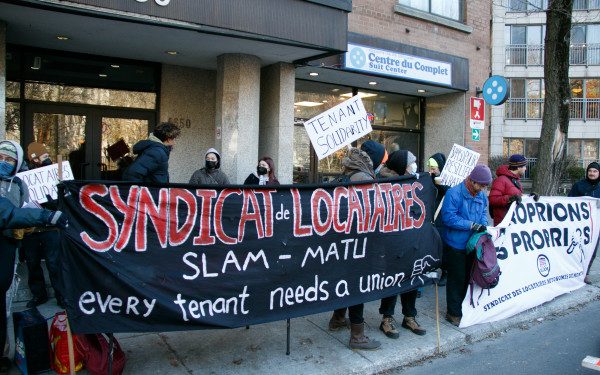
A series of protest actions and a picket line at 3801 St. Denis St. concluded with success following negotiations between the property’s owner and representatives of the Montreal Autonomous Tenants’ Union (MATU).
Representatives of MATU, some of whom live at 3801 St. Denis St., negotiated a proposed rent increase of 19.8 per cent down to no increase. Instead, as part of the deal, tenants of the affected apartment will take on the costs of electricity separately—a cost which was included in the rent in previous years.
Lior Maharjan is a representative of MATU and one of the tenants who was affected by the rent increase and renovations that the building has undergone over the past years. She said she feels touched by the support the campaign has received, following months of protest and negotiations with property owner Mario St-Cyr.
Actions against this rent increase—organized by MATU—included a picket line in front of the building as well as a boycott movement against Le Club Café, a coffee shop in the same building operated by St-Cyr and his son.
The success comes following what Maharjan said has been years of tension and minor issues between landlord and tenant.
She said that the previous landlord of the building sold the property to St-Cyr in 2022, without telling them.
“The way we found out about it was one morning, early in the morning, our apartment door was being opened and the [current] landlord was coming in,” Maharjan said.
Following that, Maharjan added that the relationship between the tenants and the landlord became slightly strenuous. According to her, several issues kept cropping up, such as their apartment door being changed without consent and renovations being undertaken with little notice.
Still, despite these miscommunications, Maharjan and her partner, Kyle Croutch, had chosen not to open up a case at the Tribunal administratif du logement (TAL).
“We didn’t want to get to a combative place [with the landlord],” Maharjan said. “It’s not comfortable for us to be in this kind of dispute, so we tried to be as respectful and communicative as possible at every point.”
Maharjan said a new problem arose in the summer of 2023.
“Within less than a year of [St-Cyr and his team] owning the building,[...] they proposed to move us out,” she said. “They essentially told us that they were going to do a lot of work on the building, a lot of which was necessary, and that they were concerned about our safety in the building while this work was happening.”
Yet according to Maharjan, St-Cyr did not acknowledge that—as stated within TAL guidelines—in a case of an apartment needing to be vacated due to major renovations, the tenants are to be moved to another place at the cost of the landlord, with the rent continuing to be paid at the same current rate.
She and Croutch ultimately opted to remain on the property. In response, St-Cyr extended the construction period to ensure that the tenants could live there safely. Still, Maharjan said that their quality of life diminished over the past couple of years, given the construction.
And just last year, she said that St-Cyr had raised the rent by 11.8 per cent. While Maharjan and Croutch had accepted that increase, she said that St-Cyr’s proposed increase of 19.8 per cent this year was too much for them to ignore.
“At this point, we were saying: ‘This is enough, this is more than we can afford,’” Maharjan said.
“There’s this myth of housing being ‘passive income’ or investment, but that’s not the reality—the income is not passive, it’s just exploitation of a tenant’s income. There’s a really dire need for people to stand up to that kind of [justification].” — Owen, MATU representative
In an email to Maharjan and Croutch, St-Cyr informed them that the value of the apartment is double what the tenants are currently paying. St-Cyr then stated that the increase is “directly linked to the expenses I incurred for the major repairs completed last year [...] to restore and make safe a century-old building that was in deterioration when I purchased it.”
Such repairs included but were not limited to the replacement of rear balconies with large terraces, the repair of the walls and exterior stonework of the building, the reinforcement of the basement, and the replacement of doors, windows and front balconies.
Maharjan said that she does not believe in the idea that market value should be the determining factor of how much rent is.
“We’re seeing market values increase because rent increases, and it’s a cycle that makes property values more valuable, and it increases rent and inflation,” Maharjan said. “If we take a 33 per cent increase in rent in two years, does that amount to a 33 per cent increase in wages in two years? In our case, it certainly does not.”
Owen, a member of MATU who was granted last name anonymity for safety reasons, has been assisting Maharjan in the efforts against the rent hike. According to him, using market value as justification for a rent increase is false logic.
“There’s this myth of housing being ‘passive income’ or investment, but that’s not the reality—the income is not passive, it’s just exploitation of a tenant’s income,” he said. “There’s a really dire need for people to stand up to that kind of [justification].”
On her end, Maharjan said she began researching the average rent in Montreal in 2024 to see if what she was paying was actually not up to par with market value standards.
According to the Canadian Mortgage and Housing Corporation, the average rent for a two-bedroom apartment in Montreal in fall 2024 was $1,176. That number was several hundred dollars lower than what Maharjan and Croutch were paying.
In a statement sent to The Link, an anonymous member of MATU wrote that: “We can't be tricked into thinking ‘average’ rent means the same thing as ‘decent’ rent. Today, average rent is a reflection of years of gentrification, booming landlord profits, and evictions of elderly and poor people.”
At last, Maharjan said that a deal was reached on Aug. 21 between her and St-Cyr, following weeks of back-and-forth both via email and in-person.
“In the end, our protests were effective enough for Mario to have a change of heart and, while offering the deal we landed on, he expressed understanding that our cause is to maintain the affordability of our home,” she said.
Ultimately, Maharjan said that while the protests were in response to her landlord’s rent increase in particular, it fell in line with the broader fight against “a tribunal and a provincial government that continues to favour landlord profits over a human necessity: housing.”
“Whether destroying lease transfers or reforming the rent increase formula to increase landlord revenues even more, the CAQ's track record shows how they have not only neglected the issue, but are exacerbating it for the benefit of the wealthy,” Maharjan said.
The Link reached out to property owner Mario St-Cyr for comment, but did not receive a response by publication date.
A previous version of this article had the rent increase amount written at 19.2 per cent instead of 19.8 per cent. The Link regrets this error.