
Montreal ceremony remembers Hiroshima and Nagasaki after 80 years
Japanese and Canadian communities honour lives lost and highlight the importance of nuclear disarmament
The Japanese-Canadian Cultural Centre of Montreal (JCCCM) and the Quebec chapter of the National Association of Japanese Canadians (NAJC) held a ceremony on Aug. 9 at the JCCCM to mark the 80th anniversary of the atomic bombings of Hiroshima and Nagasaki.
On Aug. 6 and Aug. 9, 1945, during the closing stages of World War II, the U.S. dropped atomic bombs on the Japanese cities of Hiroshima and Nagasaki, respectively. The attacks killed an estimated 150,000 to 200,000 people, the majority of them civilians. These remain the only instances in which nuclear weapons have been used in war.
While Montreal holds its annual Aug. 6 Peace Memorial Ceremony at the Botanical Garden—timed to coincide with Hiroshima’s ceremony—this year’s commemoration extended to Nagasaki’s anniversary as well, bringing together performers, organizations and community members for a full day of remembrance.
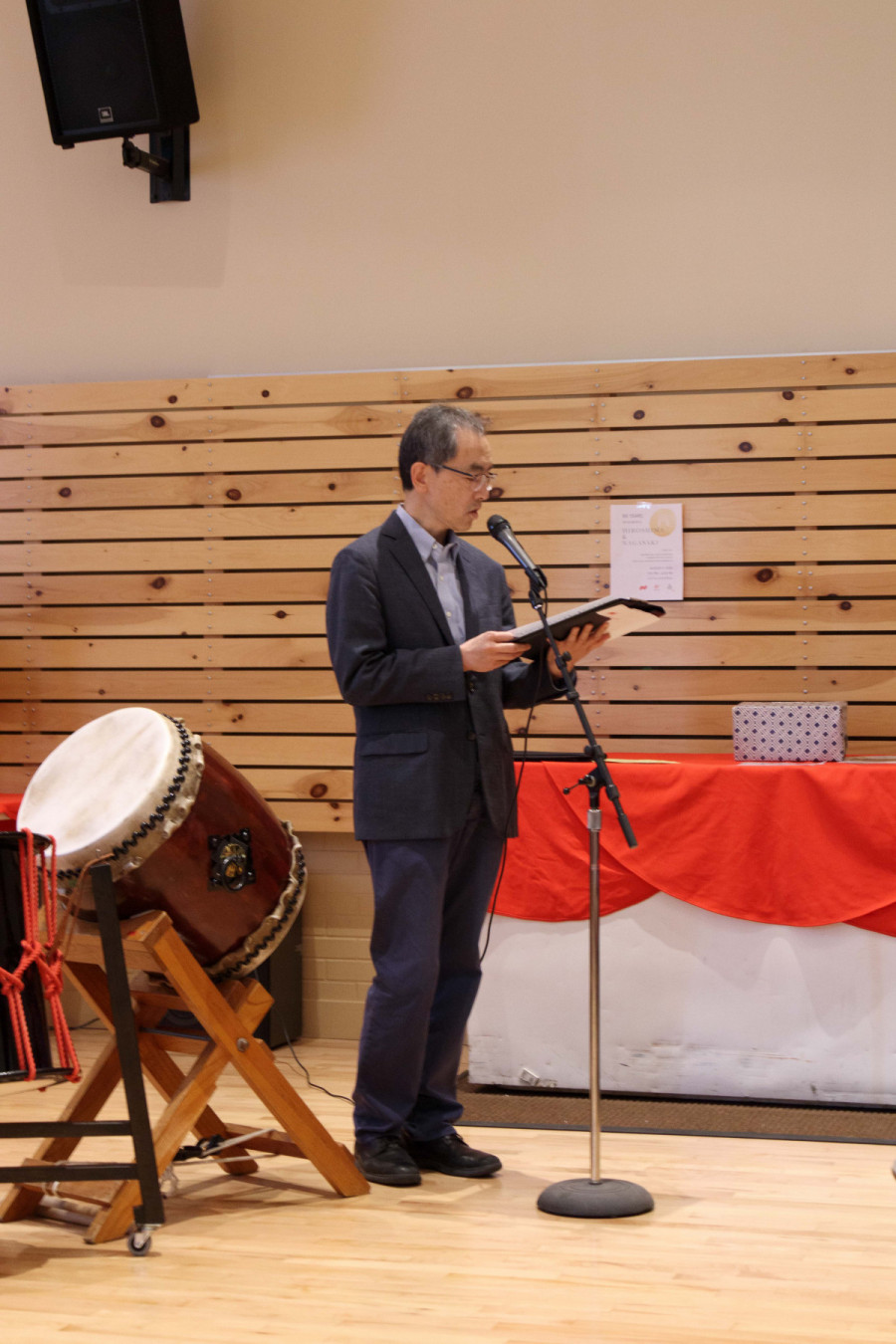
The afternoon opened with welcoming remarks from Hisako Mori, secretary of JCCCM, followed by a message from Akihiko Uchikawa, consul general of Japan in Montreal.
Uchikawa began by offering his condolences to all those affected, recalling how the bombings reduced the cities to ashes and stressing that such destruction must never be repeated. Preventing it, he said, requires understanding the consequences of these acts.
“We must make all our efforts to bring about a world without nuclear war and a world without nuclear weapons,” Uchikawa said.
He closed his remarks by expressing his hope that attendees would find both meaning and peace in the day’s tribute.
This event held special significance due to Montreal’s longstanding bond with Hiroshima—two cities united in a shared commitment to peace since 1986, when the mayor of Hiroshima delivered a speech at the International Conference on Peace and Security in Montreal. The relationship was formalized in 1998, when they officially became sister cities.
Following Uchikawa’s speech, Mariko Komatsu—a Hiroshima native and peace education advocate who studied in Montreal for several years—shared a five-minute video message from Hiroshima, expressing gratitude to Montreal for giving her the language skills to advocate for peace globally. In her work, she often invokes the tragedies of Hiroshima and Nagasaki as reminders of the human cost of nuclear war
Komatsu’s words resonated with the day’s larger message, one echoed by Mori.
“The politics of the world are unstable, and there are still nations that are producing nuclear weapons, which I think is absolutely unbelievable that after such catastrophic loss of life, that this is still continuing,” Mori said.
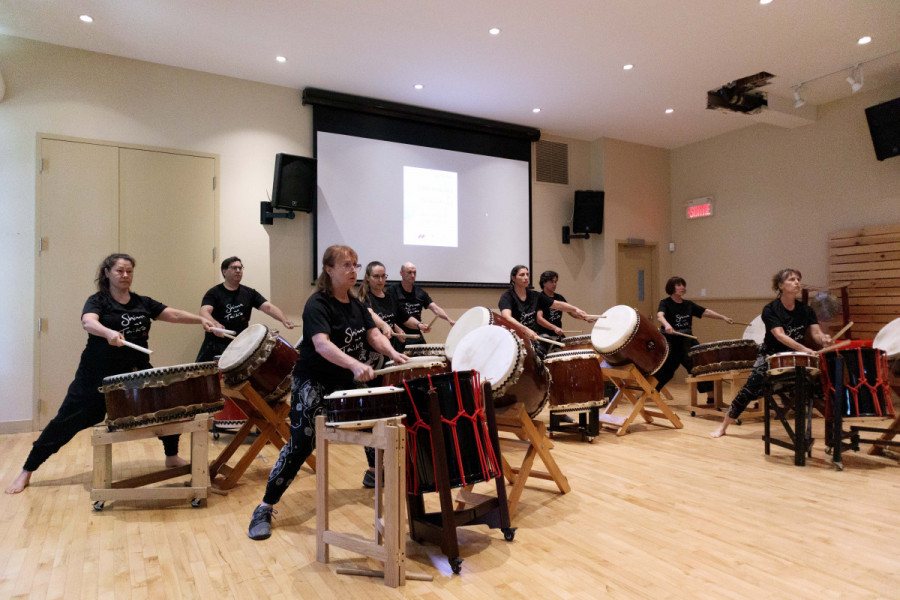
The ceremony continued with a 15-minute performance of “Sanya” by Shima no Taiko MTL, with the resonant beats of taiko—traditional Japanese festival drums—filling the room. Traditionally played outdoors in the evening, the drumming’s deep tones carried enough sound to merit the distribution of earplugs by volunteers.
“Sanya” portrays a mother’s desperate search for her daughter after the Hiroshima bombing, culminating in the devastating moment she finds her body.
“It’s one thing to talk about the need for nuclear disarmament and the need for peace, but we can get kind of caught up in the rhetoric of it,” said Sara Breitkreutz, a member of Shima no Taiko MTL, the NAJC and the JCCCM board.
“I think when you can experience a story in this more visceral way, it can have a really lasting impact on people,” Breitkreutz added.
Katsukuni Tanaka, a Hiroshima survivor who was just 10 months old when the bomb fell, also addressed the guests with the help of a French translator. Though he has few personal memories of the bombing, he lost close family members, including his aunt, who worked at a post office and whose remains were never found.
Tanaka has dedicated his life to advocating for peace.
"We hope to prevent this from happening again, which is why it’s important to build networks and get involved, because when there is war, the victims are always the civilians," Tanaka said.
He concluded his talk by removing his blazer to reveal a shirt with bold writing, where the word “peace” stood out clearly, leaving a strong visual statement with the audience.
The ceremony continued with a collective screening of Okurimono, a 2024 Canadian documentary directed by Laurence Lévesque. The film follows Noriko, a Japanese Canadian woman who returns to Japan after her mother’s death to better understand her mother’s experience as a hibakusha—a survivor of the atomic bombing of Nagasaki in 1945.
Every item on the program carried a direct thread to Hiroshima or Nagasaki, inviting attendees to remember, mourn and confront the weight of nuclear war. During the screening, the room shifted between quiet stillness and audible sniffles.
For the organizers, the purpose focused on the creation of spaces where the past could speak urgently to the present.
“There's a younger generation of people who are not as familiar with the history of World War II and what happened,” Breitkreutz said. “It's important for us to keep that memory alive, the further and further it recedes into the past, because it's a really important lesson for all of us.”
The ceremony concluded with three songs by the MTL Shamisen Project, showcasing the shamisen—a traditional Japanese three-stringed instrument known for its unique, expressive tone. The performance ranged from serene, reflective pieces to an original composition that inspired strength and resilience.
Once the ceremony concluded, attendees were invited to share conversations and enjoy refreshments at their leisure. Despite the day’s heavy topic, people connected warmly, thanking one another and reflecting on the ceremony.
When asked what she hoped people would take away from the event, Mori reaffirmed the importance of remembering past tragedies, keeping conversations on disarmament alive and strengthening global solidarity.
“It’s important to maintain this message of hope and reconciliation,” she said, “and to remember that we must take care of our earth for future generations.”



_600_375_90_s_c1.jpg)