La traversée du siècle turns Montreal into a living archive
Recasting Michel Tremblay’s world with Marlène Gélineau Payette’s lens
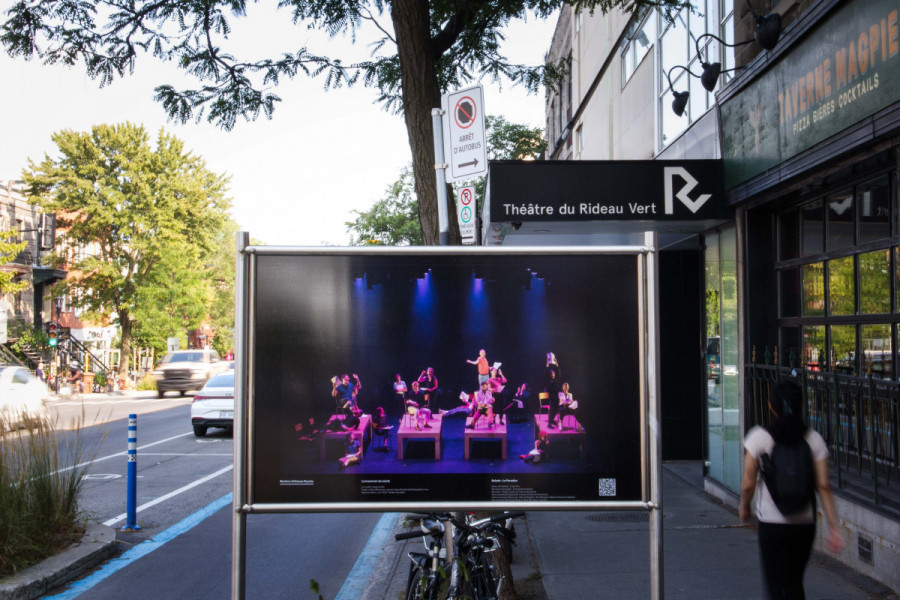
This summer, theatre has stepped off the stage and into the city.
Seventy-two large photographs by Montreal still photographer Marlène Gélineau Payette have been installed outdoors across a network of streets and public spaces linking the Plateau, Quartier des spectacles and adjacent neighbourhoods.
Each image captures a suspended moment from La traversée du siècle—a bold, 12-hour theatrical epic written and directed by Alice Ronfard in close collaboration with the late André Brassard.
Woven from Michel Tremblay’s best-known novels and plays, the play follows three women—Victoire, Albertine and Thérèse—whose lives span a century of Quebec’s social and cultural evolution.
The production moves seamlessly between tragedy, comedy, intimacy and grandeur. It paints a wide and detailed portrait of Quebec society, touching on issues like identity, class, queerness and the struggle to survive. Though firmly rooted in Quebec’s history, the themes still echo today, reflecting ongoing social and cultural conversations.
To document the project, Gélineau Payette followed each of the seven stagings, capturing emotional fragments that now form a citywide exhibition. Installed near the very theatres where the play ran, the photographs also trace a path through streets mentioned in the story itself.
"I feel like everything just seemed to come together easily when I started building the project,” Gélineau Payette said about the location of the different exhibitions.
The seven theatres also form a rough square across the city, with La Fontaine Park—another central setting in Tremblay’s universe—at its heart.
Accompanied by a six-part podcast produced by Espace Libre—equal in length and structure to the performance—the exhibition becomes more than a memory. It’s a theatrical experience meant to be walked, heard and seen across the city.
For Gélineau Payette, it’s that very connection to the city that makes the project so special, rooting it with a deep sense of attachment and place.
“When you follow the characters through the Plateau Mont-Royal—which Tremblay wrote about in the ’70s and '80s—it’s exactly like my parents’ families. That’s where we come from. So, there’s definitely a sense of belonging,” Gélineau Payette said. “And then, when you’re out for dinner or just walking around, you start noticing things.”
The project began as a photo book, intended as a gift for the actors and collaborators—a behind-the-scenes keepsake capturing not only the play itself, but also its backstage moments and raw in-betweens.
After often seeing photographs displayed while walking through the city, Ronfard suggested to Gélineau Payette that the images should live on in public space, sparking the idea of turning them into an exhibition.
“I find it beautiful to see actors taking over the city with a true story. What’s also wonderful is that the creative work is a project that moves around. It’s multifaceted,” Ronfard said. “It starts as a novel, then becomes a play. After that, it turns into a photo album, and then those photos become part of the city.”
While Gélineau Payette loved the concept, bringing it to life came with its own set of challenges. The displays across the city are managed by different organizations, meaning she had to navigate various people, approval processes, and, at times, even cover costs out of pocket.
Creatively, the project made sense, but distilling the story into just 72 photographs required tough decisions.
“At one point, I found myself stuck. I really liked a photo, but the podcast audio clip didn’t work well with it,” Gélineau Payette said. “I was really working on both in parallel—the audio and the image. I listened to it again and again, trying to make sure I was giving people enough context to follow the story.”
And this careful curation has resonated across the city all summer long.
Quebecois comedian and director Martin Faucher happened to see two sections of Gélineau Payette’s exhibition while walking along Mont-Royal.
“I can only repeat that La traversée du siècle is a major event in Quebec theatre,” he said. “It’s fantastic that this moment was captured through [Gélineau Payette]’s sensitive eye. Now, a new audience has access to Tremblay’s universe, but it’s also a celebration of the actors, the theatres and the very spaces that make up our urban fabric.”
Even if you’re unfamiliar with Tremblay’s work, La traversée du siècle can serve as an immersive entry point into his artistic universe.
The emotional depth of Tremblay’s characters—their struggles, hopes and humanity—was something Gélineau Payette felt keenly while crafting the exhibition.
“Many people talk about Tremblay’s characters as living in hardship, but they’re human,” she said. “It’s like Les Misérables, it’s about misery, yes, but also about resilience and hope. These are characters who hope.”
When asked what she hopes newcomers will take away from her play, Ronfard encouraged curiosity about Quebec’s literary heritage.
“What matters, for me, is inspiring people to read his works, to read Michel Tremblay, and to understand that he’s a poet who has deeply influenced francophone Quebec theatre,” she said.
The exhibitions will not remain on view for the same amount of time. Parts 1 and 2, along with Part 5, will remain until spring 2026. Parts 3 and 4 come down on Aug. 27, while Part 6 wraps up on Sept.16. That leaves just under a month to experience the full sweep of the project.
Thinking back on how she felt at the end of each performance, Gélineau Payette took a deep breath.
“Oh my God, what an extraordinary journey we’ve shared,” she said—a journey anyone can still experience throughout the city this summer.