‘I saw a country that was absolutely destroyed,’ Palestinian-Canadian doctor says
Activists and frontline workers recently returned from Gaza share their experiences
Content warning: mentions of violence and death.
“When I was in Gaza, we would watch 100 people come by and then die in the span of a day, because our hospital was the only functioning hospital in Gaza at that point,” said Dr. Tarek Loubani, a Palestinian-Canadian doctor who came back to Canada in September after treating people in Gaza for a few months. He spoke to a crowd of around 200 people.
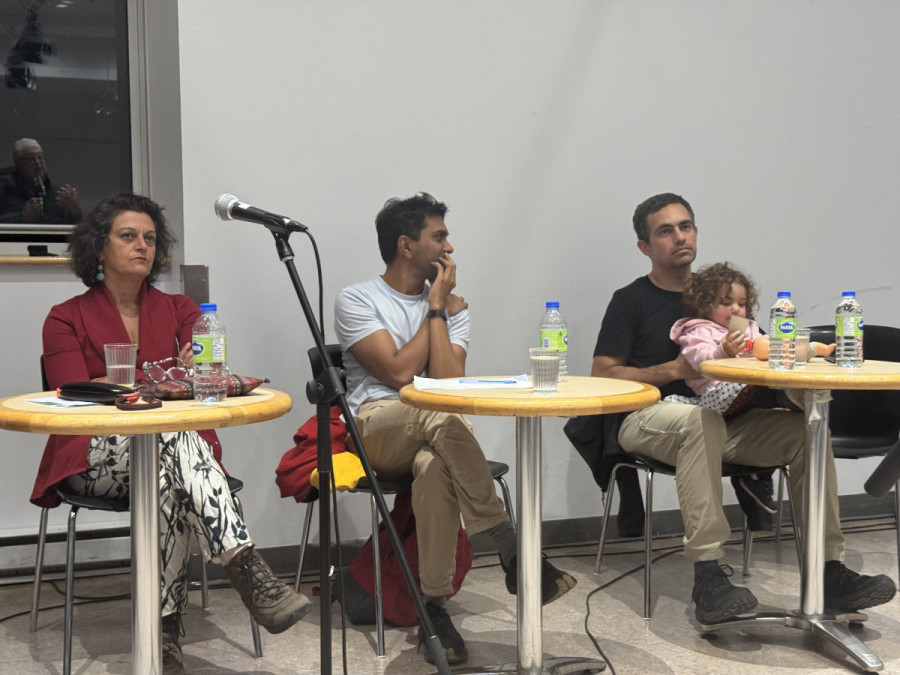
Loubani was joined by Dr. Baijayanta Mukhopadhyay, who worked in Gaza as a doctor, as well as Nimâ Machouf, a member of the recent Freedom Flotilla who attempted to break the siege on Gaza by sea.
The three activists and frontline workers shared their experiences as eyewitnesses to the genocide in Gaza at an “Resisting Genocide: Eyewitness Accounts” event hosted at the Centre culturel Georges-Vanier on Oct. 23.
The panellists were introduced by the event’s organizers, members of Montreal’s chapter of the Palestinian Youth Movement, Independent Jewish Voices (IJV), The Caring for Social Justice Collective, Ismailis For Palestine and Médecins du Québec Contre Le Génocide à Gaza.
The event also sought to raise funds for Glia, a medical solidarity organization run by Loubani, that aims to provide low-cost, low-resource, open-source medical supplies to impoverished and developing nations, with organizers hoping to raise $50,000.
Machouf spoke first and and detailed her experience as one of the activists on the Freedom Flotilla boat The Conscience. The Conscience was one of nine vessels carrying 145 activists from 30 different countries headed to break the siege on Gaza and deliver humanitarian aid earlier this month.
On Oct. 8, the Freedom Flotilla Coalition released a statement that the Israeli military had abducted all 145 activists from the boats. According to legal experts, these interceptions are a violation of international maritime and humanitarian law.
Machouf said that Israel’s interception of the Conscience was aggressive.
“They acted as if we were an enemy army,” she said.
She was accused of illegally entering Israel and was detained, describing the detaining of all activists on board as violent. She said that they were forced to walk bent over, forced to kneel down for hours in a high-security prison.
“We knew they couldn’t kill us. We weren’t afraid for our lives and despite the violence, their action did not discourage anyone from attempting to break the siege again,” Machouf said. “There is no one [out of us] who said, ‘I will not come back, I will not continue the movement.’ The question was: are we coming back with our clothes, or prisoner clothes?”
Dr. Mukhopadhyay was in Gaza in June of this year and drew parallels between his experience in Gaza and settler colonialism in Canada, mainly through his experience as a physician practicing in remote and Indigenous communities in northern Quebec.
In his speech, Dr. Mukhopadhyay connected Indigenous healthcare struggles with those in Gaza through the Blackfoot hospital. The hospital, which was built on the Siksika Nation in Alberta in 1924, operated for several decades before it was closed due to discriminatory underfunding from the government. He said that it was part of a larger, segregated system across Canada that has been linked to medical racism, patient neglect, and experimentation.
“In that moment, I had this overwhelming surge of humanity and recognition that this boy, in front of me, was a human being, not an equation.” — Dr. Tarek Loubani, Palestinian-Canadian doctor
“The undermining of autonomous healthcare, autonomous ways of caring for their communities, is something that is reflected in Gaza. There is a pharmaceutical industry in Palestine, but the amount of barriers that are placed on it by the occupation makes it really hard to thrive,” Mukhopadhyay said.
Loubani took the microphone next and spoke for nearly an hour, detailing his experience witnessing the Palestinian genocide and the ruin of Palestinian land over the years.
“When I went to Gaza, what I saw was a country that was absolutely destroyed; that was ground down, you could smell the stench of bodies in Gaza City,” he said.
When speaking, Loubani talked about a hospital case that he says broke him. He said that a boy, no older than 4 years old, was hit by shrapnel while sleeping in a tent. His whole family was killed.
“I put an ultrasound on him, and there was blood everywhere,” he said. “He was getting pale, he was looking, [but] he didn’t cry. He just looked at me, and I thought nothing of it. I looked at him like a piece of meat.”
Loubani explained that with no food in the country, no family, and a lack of medical care in the post-operative period, he made the decision—as the most senior doctor in the room—to let the boy go.
“It was only after I saw his heart stop moving, because I watched it on the ultrasound until it took its last beat [...] I finally declared him [dead],” Loubani said. “In that moment, I had this overwhelming surge of humanity and recognition that this boy, in front of me, was a human being, not an equation.”
After Loubani concluded his speech, the packed room gave a standing ovation to the Palestinian doctor, who was holding his daughter throughout his entire hour-long talk.
The night ended with Loubani encouraging attendees to keep fighting for the Palestinian cause and, alongside the other panellists, taking questions from the crowd.