Cho Dem’s intergenerational celebration of cuisine and culture
Montreal’s Vietnamese food festival returns for its third edition
Back for its third year, Cho Dem, Montreal’s Vietnamese food festival, took over the Peel Basin from July 18 to 20.
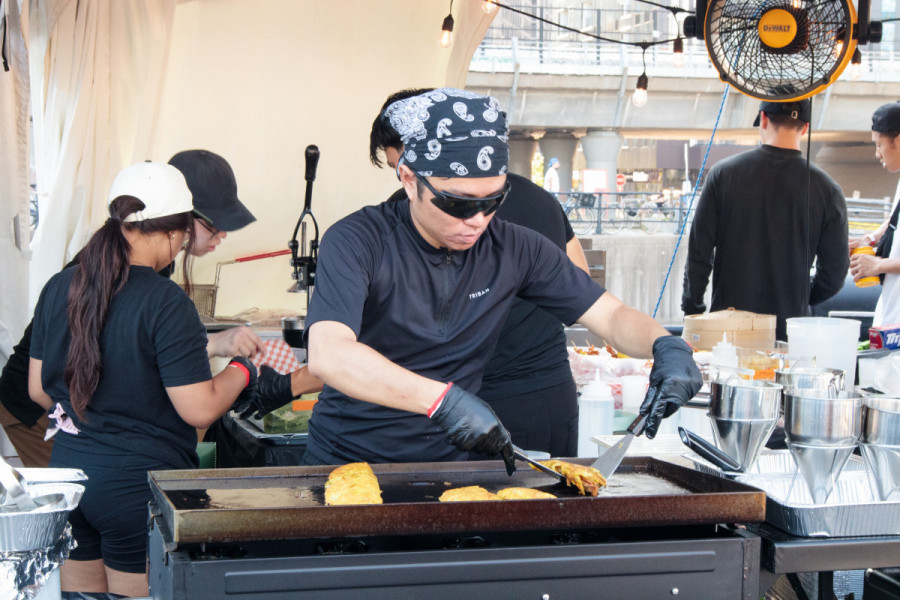
The air was filled with the scent of sizzling skewers and bánh xèo as visitors weaved between booths serving pandan matcha lattes and sugarcane juice. With close to fifty vendors, live music and workshops, the event recreated the energy of a Vietnamese night market in the heart of the city.
A group of young Vietnamese Montrealers launched the festival by forming the nonprofit Association Vietnamiens Québécois (AVQ), dedicated to supporting projects rooted in community and culture.
Charles Nguyen, one of Cho Dem’s cofounders and AVQ’s vice president, said that there hadn’t yet been a festival centred on Vietnamese food and culture. That absence was what sparked the idea of Cho Dem.
“We felt that it would be important for our members to be able to unite under one roof, or should I say in this case one place… where we can assemble around food and around the arts because it's a great way to convey the culture,” he said.
This year, in particular, carries a deeper meaning, as it marks 50 years since the arrival of the first Vietnamese refugees in Canada following the fall of Saigon. Many settled in Montreal, where the community has continued to grow steadily. What began as a wave of displacement has become a multigenerational presence, deeply tied to the city’s life.
Nguyen highlighted how Montreal’s Vietnamese community spans three distinct generations: the refugees who first arrived, their children, and the more recent arrivals who didn’t experience the war firsthand. These groups haven’t always connected easily.
That sense of connection is reflected in the festival’s growing popularity. Nguyen estimated that attendance doubled from 25,000 last year to around 50,000 this year.
The festival stretched across two docks at Peel Basin. The south and smaller dock, called the Chợ Bến Thành, felt intimate with its shaded tent, artisan stalls and a cosy stage. The north and larger dock opened up with rows of individual tents, the main stage, the majority of food vendors and a diverse mix of artisans.
Strings of lanterns crisscrossed overhead, glowing softly as they guided visitors to the main stage. On one side, Montreal’s skyscrapers rose sharply against the sky, their glass reflecting the afternoon sun. On the other side, the bright red Farine Five Roses sign stood out against the skyline.
Each summer, Montreal’s calendar is filled with food festivals that spotlight different Asian diasporas, such as the Chinatown Night Market in August and Yatai, a Japanese food festival held each June.
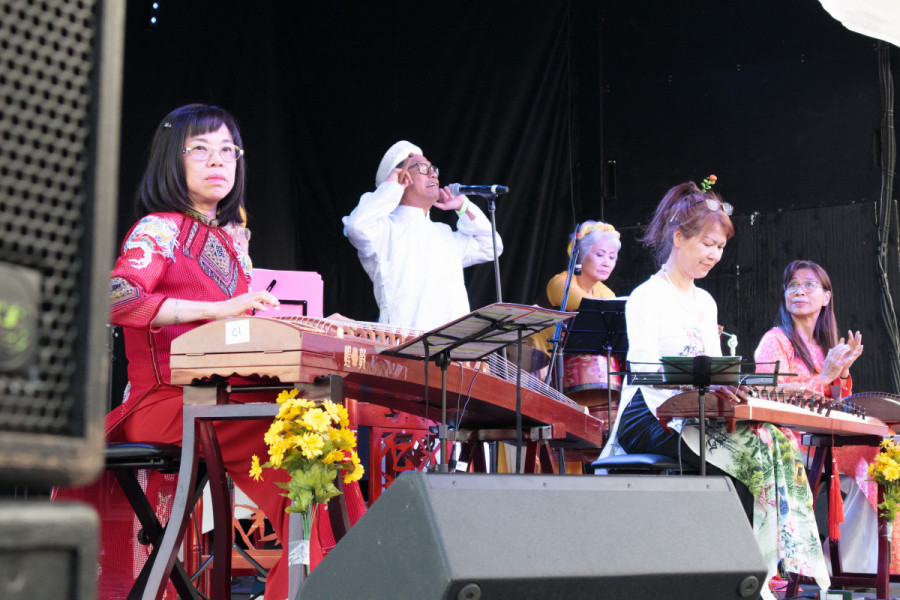
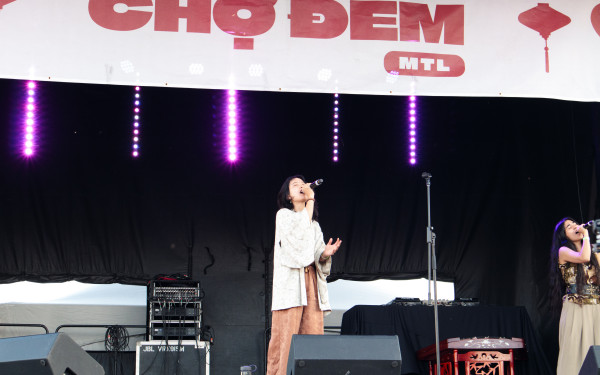
Over the span of three days, festival-goers could wander between food stalls, hop into a spice workshop or catch live performances. One of the most striking details was the blend of modern and traditional music—from Yogomi, whose angelic, aurora-like vocals lean toward folktronica, to Ban Nhạc Dân Tộc Montreal, who played traditional Vietnamese instruments.
“A lot of Vietnamese people know these songs, but they don’t know where they come from,” the members of Ban Nhạc Dân Tộc Montreal said before playing the second song in their set.
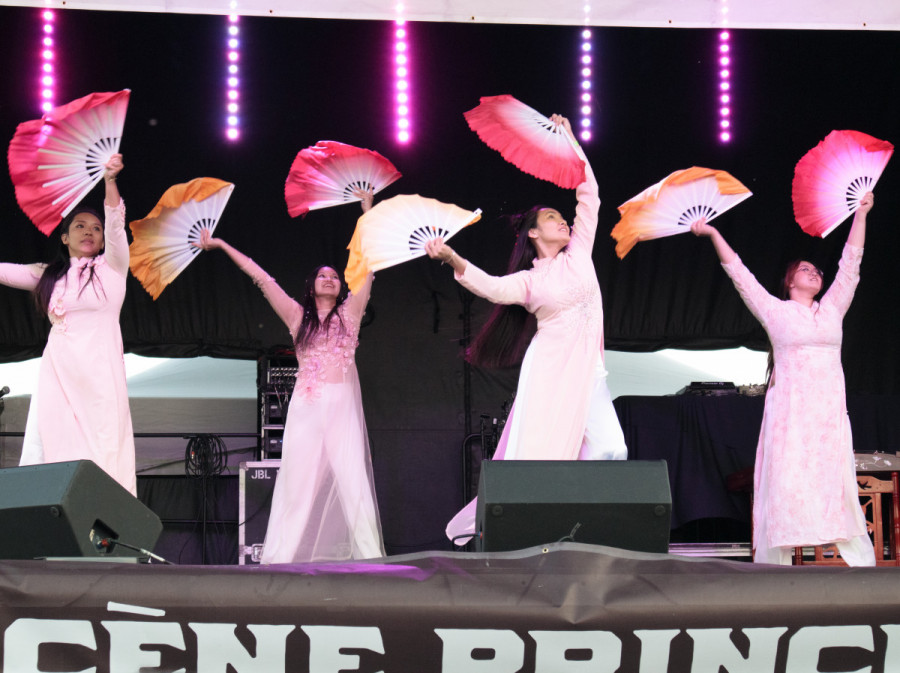
For Vy Nguyen, one of the dancers in the traditional Vietnamese fan dancing group Pray’NSlay, this intergenerational space is what made the event so meaningful.
“It’s so hard to get our elders to come out of their homes, out of their comfort zones,” she said. “Just seeing them spend the time and energy to be here with us, out in the sun, on a hot day like this, is so touching.”
She also expressed gratitude for the festival’s space.
“The biggest thing for me is that Montreal has given us such a big, lovely stage,” Vy said. “So that we can promote our local Vietnamese businessmen and women, our local artists, because I feel like Montreal is so underrated. We have so much talent, and we’re always the underdog. This is the opportunity for Vietnamese Montrealers to come up.”
Chhea-Pichpeakdey Ly and Raquel Nueva attended the festival together, with Nueva bringing Ly for his first time to enjoy Vietnamese food, a favourite for both.
What stood out to them was the festival’s organization, especially the waste triage system. Vendors served food and drinks in reusable cups, plates and bowls, and multiple sorting stations made it easy to separate waste and return reusable materials.
“And the location is great,” Nueva said, noting the canal as a scenic backdrop.
While hopeful about the festival’s future, Charles Nguyen emphasized the ongoing challenges of organizing an event run entirely by volunteers without a permanent venue—a common hurdle for many Asian food festivals. He expressed the need for “more active dialogues with the different levels of government to help,” especially as the festival continues to grow.
“The merit to having a permanent place to be able to host these, so that way it's done in a great manner where people are not only enjoying it, but it's also safe,” he said.
Despite the challenges, the festival continues to be a space for discovery and connection.
“At the end of the day, that is our hope, to spark just the right amount of curiosity,” Charles Nguyen said, “for every festival goer to learn one new thing, whatever it may be.”



_600_375_90_s_c1.jpg)