
Call it fate, call it Loyola
The empty promises and uncertain future of Loyola campus
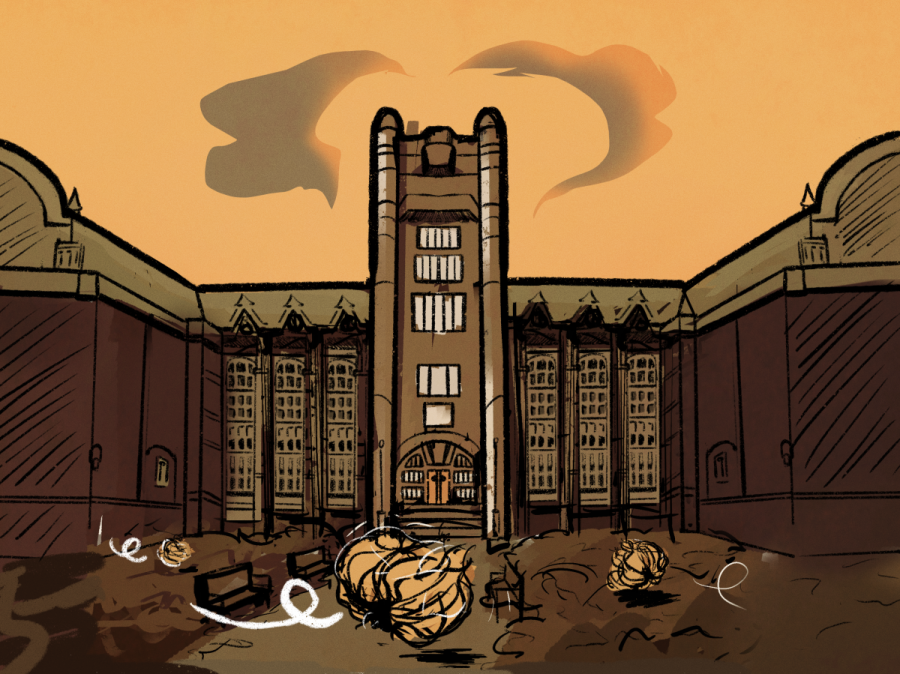
A campus tells you a great deal about how a university expects and encourages its students to spend their time. I think about this whenever I have a class at Loyola campus.
It will be late afternoon. I will run into the CJ building, and the doors will clack shut behind me with resounding conviction. In the basement, a voice will carry from the red couches, someone on the phone whom I will not actually see. I will take the elevator up two floors, not because I need to, but because it is there, and because nothing else in the building suggests I should exert myself for it.
I will reach the classroom and exhale, the particular relief of finding a room that is, against all odds and expectations, occupied.
There will be roughly ten of us and a professor. It will feel almost intimate and unsettling for that same reason, because just outside that door, there is no student life to speak of.
At the break, I will step back into the hallway and into the same quiet I left an hour ago. My only option for food past 5 p.m. will be a vending machine.
When class ends, we will all move through the hallways like people evacuating, the unsettling silence propelling us to our cars and bus stops.
Many of my Loyola courses have been held in the evenings, so perhaps I am simply catching the campus asleep.
But to linger here is not to feel strangeness so much as absence, proof that nobody has thought this place worth the trouble of caring for.
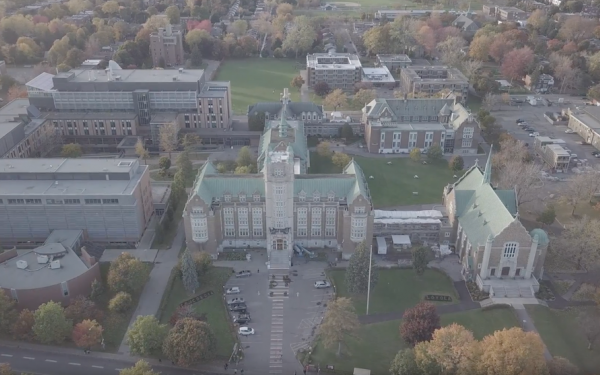
Loyola has plenty of space. In fact, it is the closest thing that Concordia University has to a traditional, sprawling university campus.
Concordia's own 2024 Campus Master Plan promises that Loyola will become a "vibrant, year-round campus environment" through diversified indoor and outdoor spaces and revitalized underused areas.
A plan, like most plans, written in the confident future tense.
Yet this very plan was finalized the same year the university cut down the hours of the shuttle connecting Loyola to downtown, citing a $34.5 million deficit and showing no intention of restoring the vital service.
It is no surprise that a vision is the cheaper thing to fund.
What no amount of talking can buy is the feeling of a "third place," Ray Oldenburg's term for the space that is neither home nor work, somewhere you go for no defensible reason at all.
Universities like to believe they provide these. Mostly, they provide rooms. The difference between the two comes down to smaller intentional decisions.
I claim no expertise in furniture, but I do have years of sitting in the consequences of someone else's decisions to feel strongly about it.
A twenty-five-year study of public space in Davis, California, found that people do not sit where chairs are provided; they sit where chairs can be moved, dragged into the sun or turned toward a friend. Given the choice, 70 per cent chose the moveable chair over an identical one bolted down.
A sense of belonging at university is difficult to manufacture through orientation week posters and student-success campaigns alone. It is built through the repetitive mundane.
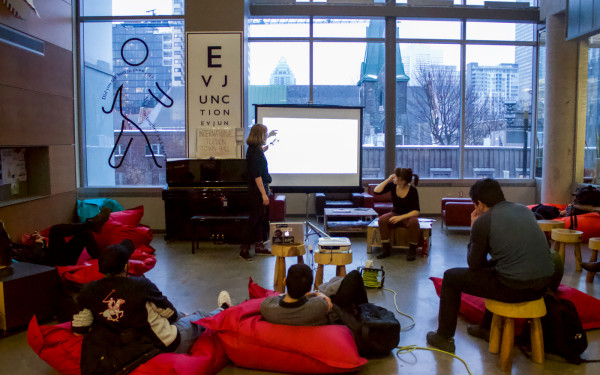
At Loyola, in the SP building, most of the seating is fixed in place. Not to mention the comfortable booths, which have covering peeling off them like old paint. Even where furniture can be moved, in the CJ building's atrium, for instance, a handful of round tables sit lined against the windows, arranged with the clean and clinical spacing of a waiting room.
And this goes beyond what a campus looks like.
RMIT University in Melbourne piped birdsong into a courtyard, and a 2023 evaluation found visitors lingered longer and left calmer. The Hall building at the SGW campus has added birdsong of its own, though why remains unconfirmed.
Loyola's silence has received no such attention.
A sense of belonging at university is difficult to manufacture through orientation week posters and student-success campaigns alone. It is built through the repetitive mundane.
Loyola, I wanted to love you.
What I will leave with instead, after four years, is something harder to name than disappointment. I will look back with a particular sadness of unused space and the sense that you were capable of so much more than you were told to be.
This article originally appeared in Volume 47, Issue 1, published September 8, 2026.



_600_375_90_s_c1.jpg)