
CABARET: The Dancing Djinn brings queer Arab histories to life on stage
A story of exile, desire and revelation told through voice, body and myth
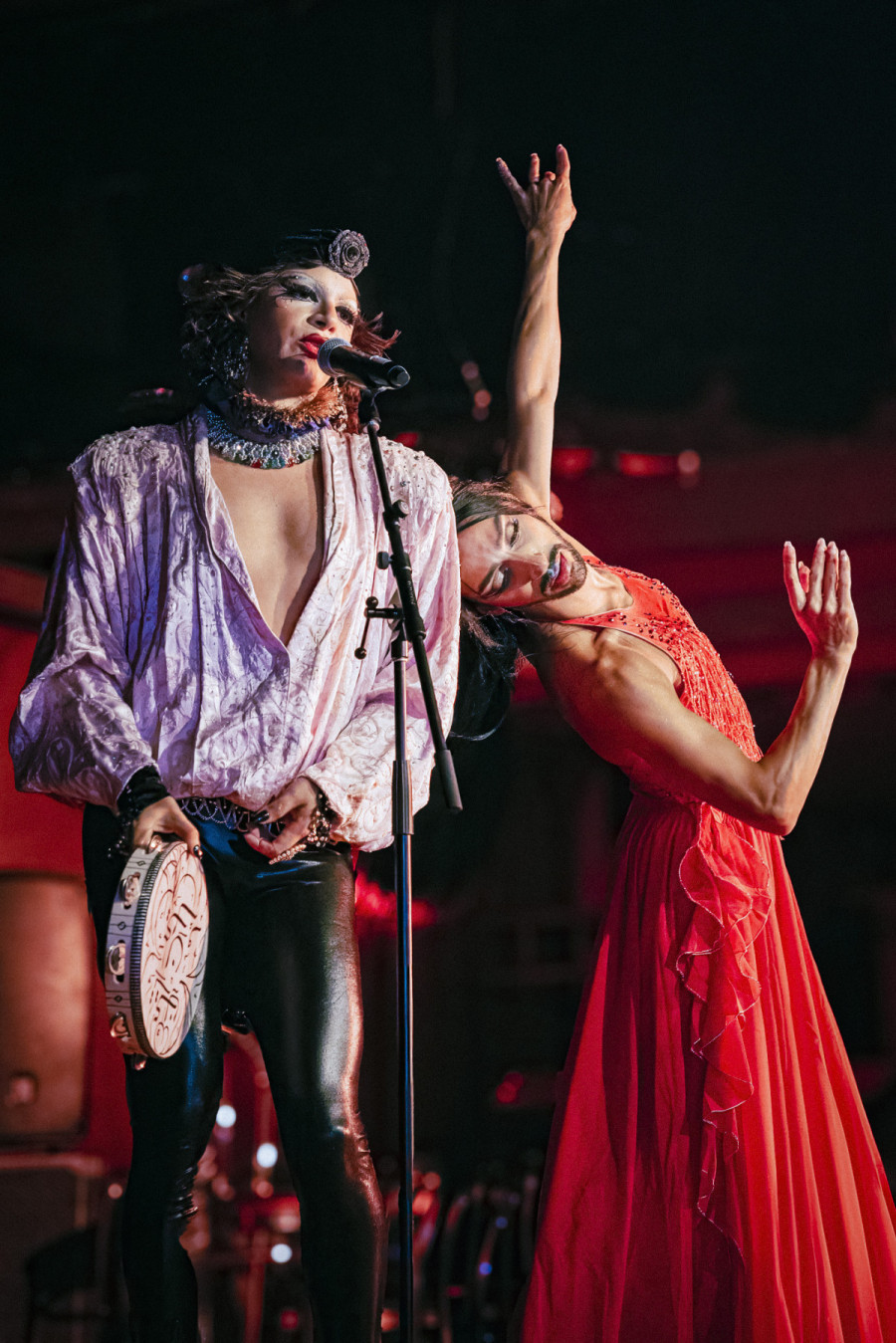
CABARET: The Dancing Djinn is the latest addition to Montreal’s queer arts scene.
Created and performed by artist and singer Nikotine and dancer Samara, the show combines a mix of drag, bellydance and live music that not only entertains but offers something rare on stage: a celebration of queer Arab histories told through myth, memory and performance.
The project’s origins trace back to two moments. During a visit to Granada’s Alhambra palace, Nikotine stumbled upon the long-overlooked legacy of queer Arab performers. Through the work of historians Dr. Ali Olomi and Dr. Borjan Grozdanoski, she encountered the mukhannathun—trans-feminine performers who sang, danced and thrived in medieval Andalusian high society.
Seeing traces of their history reflected in the palace’s art and architecture felt special. Soon after, she crossed paths with Samara at a party. Nikotine, already familiar with Samara’s dancing, immediately felt she had found the right partner to revive these legacies.
The duo first came alive with a Shakira-Assala Nasri mashup at Woody’s in Toronto, where Nikotine’s vocals met Samara’s belly dance. The 10-minute set ended with a standing ovation and a flood of tips, turning the spontaneous collaboration into the seed of CABARET: The Dancing Djinn.
Onstage, Nikotine wanders through a desert clutching a magic lamp. The barren landscape becomes a symbol of isolation and silence, reflecting moments in her life where queerness was pushed to the margins. Inside the lamp waits Samara, revealed as the spirit of the banished Queen of Queerabia.
“We built this whole concept on what my strengths were as Nikotine and what Samara’s strengths were as Samara,” Nikotine recalls. “Now we’ve become soul sisters. We’re inseparable.”
Together, they guide the audience through memory, myth and desire. For some in the crowd, that journey lands with particular force.
“As an Arab queer person, their story and energy touched me so deeply,” says Muha, a fan who drove 14 hours from Halifax to Montreal for the show. “It was worth every single minute. I’d do it again in a heartbeat.”
The cabaret is deliberately immersive, with Nikotine at its centre in the first number. She appears clutching a lamp, terrified of what it contains. Her fear is palpable: she knows the djinn inside holds answers she has long avoided or repressed. That tension ripples out into the audience as Samara circles veiled and spectral, her movements heightening the atmosphere of dread.
But when the second number begins, the focus shifts. After Nikotine flees, the audience encounters Samara on her own for the first time. The veil lifts, revealing not a monster but a force of liberation. By the end of the first act, Nikotine and Samara encounter each other for the first time, instantly falling in love.
_900_1349_90.jpg)
This revelation also reveals the root of her fear: queerness itself has been vilified historically, particularly after colonization.
“What Samara truly is, is this sexy, beautiful, sensual djinn [...]. Welcoming queerness and sensuality back into our lives as a key part is what Samara represents,” Nikotine explains.
Samara frames the project as correcting the record.
“We wanted to tell the story truly how it is. What we lived through, inspired by the past, that was wiped out by colonialism, crusaders, religion and politics,” she says.
Since its first Montreal show in January 2025, the duo has sold out venues like Café Cléopâtre and drawn audiences from across Canada. But the appeal doesn’t come solely from the music or choreography, but also in the way the cabaret turns spectators into participants.
True to the old-school cabaret form, the show relies on intimacy. Nikotine leads sing-alongs, Samara pulls people from their seats to dance, and the line between performer and audience blurs.
The lamp, carried by Nikotine throughout the story, becomes more than a prop. It represents the secrets we all carry, and the possibility that the answers to repression and fear lie within ourselves.
By the finale, hidden lamp keychains taped under every chair are revealed, making the audience literal keepers of the story’s secret. It’s a reminder that freedom, reclamation of sexuality, and joy aren’t given by others; they already exist within us, waiting to be unlocked.
Self-funded and produced entirely by the two performers—who write the music, choreograph the dances, design costumes and market the show—CABARET: The Dancing Djinn is as much a feat of resourcefulness as it is of artistry. Their next performance sees them travel to Toronto in September 2025, with plans for Montreal in January 2026 and eventual tours in Paris, Barcelona and London.
With its fusion of history, myth and radical queer joy, CABARET: The Dancing Djinn isn’t just a performance. It’s an act of remembering, reimagining and reclaiming—an invitation for audiences to take the lamp, hold it close and dance their truth.



_600_375_90_s_c1.jpg)