Beading across generations
Juliet Mackie keeps Métis beadwork tradition alive through her shop, Little Moon Creations
_900_1200_90.jpg)
Juliet Mackie was introduced to beading at a young age through her grandmother, who often stayed busy crafting at the kitchen table, creating traditional Métis art such as birchbark baskets or beading moccasins.
Beading has long been woven through Mackie’s family history. Her mother, Cathy Richardson Kineweskwêw, shares fond memories of beading with Mackie all around the world, from Aotearoa to Hawai’i and Wales. Together, they have carried this practice across continents and generations.
“It’s a very grounding practice that connects [Métis people] to their culture and makes them feel like they are embodying a living practice,” Mackie said.
She added that beading helps her feel connected to her family and ancestors who practised the same art before her.
Mackie initially found beading difficult as a teenager and didn’t have the headspace to make it a regular practice. It wasn’t until her undergrad in 2016 that she came back to beading after facilitating an arts and crafts workshop during a volunteering internship at the Montreal Native Women's Shelter. Mackie recalls excitedly calling her grandmother after beading a keychain.
Then in 2019, she took an earrings-making workshop with Cory Hunlin, the founder and maker of This Claw, a business that sells beadwork earrings. The rest is history.
“I found that practice right before COVID, so then I had so many earrings, I was giving them as gifts,” Mackie said. “It was also very helpful for my mental health to have something to do, a very mindful practice, so that really distracted me and kept me occupied.”
Mackie launched her Etsy shop, Little Moon Creations, in fall 2020. Anyone can wear her earrings, unless listed otherwise. Today, Mackie operates the business entirely on her own, from making the earrings to packing orders to doing the mail runs.
“I'm really proud of Juliet,” her mother, Richardson Kineweskwêw, said. “I believe she is channelling our ancestors who worked with beads many generations ago.”
Curator and friend Alexandra Nordstrom met Mackie in 2018 when they co-curated an exhibition together and have collaborated on many projects since. Nordstrom even curated Mackie’s first solo show, Matrilineal Memory, at the Shé:kon Gallery in 2023.
“It’s been such a pleasure to witness Juliet grow Little Moon Creations,” Nordstrom said. “Juliet's business carries a broader significance, sustaining and innovating within contemporary Métis beadwork. [...] She brings beauty and confidence to people all over the world by selling her wearable art.”
The Métis people represent one of three recognized Indigenous groups in North America. Mackie’s Métis family traces its roots to Fort Chipewyan in Alberta and Red River, but she grew up a citizen of the Métis nation of British Columbia, in the small fishing village of Cowichan Bay.
“Being near the ocean is very important to me,” Mackie said. “Just spending time in that sort of ecosystem is really comforting.”
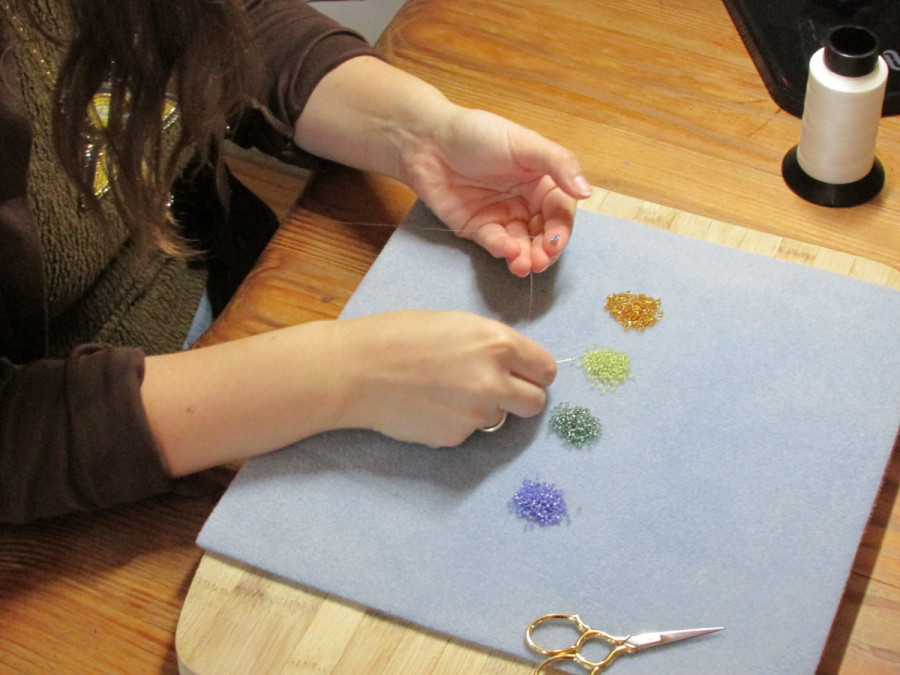
Mackie explains that Métis beadwork is important not only because it connects people to their ancestors, but because it's a living practice that was not always accessible due to colonization or forced assimilation—times when many cultural practices were outlawed or banned.
“Many Indigenous families were impoverished by colonization and are now applying their energy, creativity and resources to build businesses that are productive and life-sustaining,” Richardson Kineweskwêw said. “Buying from Indigenous artists can be considered an act of reconciliation.”
Mackie’s work reflects that principle. All of her earrings are unique and one of a kind. She does not replicate an earring more than once. That’s why she finds it especially frustrating when fast fashion companies like Temu and Shein appropriate Mackie and other Indigenous artists’ designs.
“They are not made to last. Who knows what conditions they are being made in, whatever’s going on,” Mackie said, expressing her concerns over the matter.
“It’s unethical,” she added.
Mackie said supporting fast fashion brands fuels a cycle of exploitation that harms Indigenous artists who rely on their art for income.
“Ethical purchasing can promote social justice and help community members, particularly women, many of whom are mothers,” Richardson Kineweskwêw said.
Another major hurdle came when U.S. President Donald Trump got rid of the duty-free “de minimis” shipping exception, meaning all packages under $800 are now subject to border fees. This has deterred many of Mackie’s American customers, who make up between 35 and 45 per cent of her buyer base.
Instagram has also become a challenge. Once a thriving platform for audience growth, it is now harder to rely on. The new, non-chronological algorithm introduced by Meta makes it less likely that followers will actually see her posts unless she pays for advertising.
“You’re just giving them money when they could have just been showing your work to the people who want to see it,” Mackie said.
To adapt, she now sends out a newsletter to stay connected with her customers. She admits the change has frustrated her and slowed her momentum over the years, though her efforts still work.
Despite the obstacles, Mackie said starting Little Moon Creations has brought many positives into her life, including a strong and supportive network of beaders across Montreal and North America.
“It's brought a lot of community and connection to my life,” Mackie said.
Her friends also celebrate her success.
“She brings beauty and confidence to people all over the world by selling her wearable art,” Nordstrom said.
Even with her business, Mackie said her favourite memories involve beading with her mother and grandmother. She recalls how, even in old age, when cataracts made it hard to see, her grandmother would still spend hours on little earrings.
“She was very in awe of my work and very supportive,” Mackie said. “That was a really nice thing that we shared.”
Her grandmother taught Mackie's mother to bead, and the tradition continues today.
“We sometimes listen to music, sit with family or just talk with each other, catching up on our news,” Richardson Kineweskwêw shared. “It's so lovely to be working with our hands and feeling calm and relaxed together.”
Mackie plans to keep beading. Though she dreamed of expanding Little Moon Creations, she now prefers to keep it small-batch, producing one-of-a-kind pieces made by herself.
“I would be so excited and grateful if people were still interested and supported me,” Mackie said. “That’s the dream, really, to just make stuff and have people enjoy it.”
This article originally appeared in Volume 46, Issue 3, published September 30, 2025.