Accounts from Montreal protesters detail police violence
“Police exist to defend an oppressive social order,” police violence expert says
Content warning: Mentions of violence.
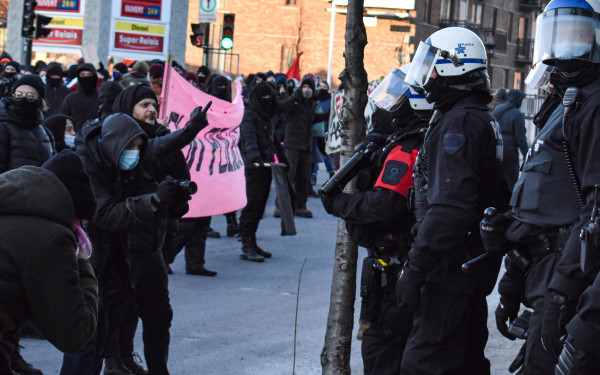
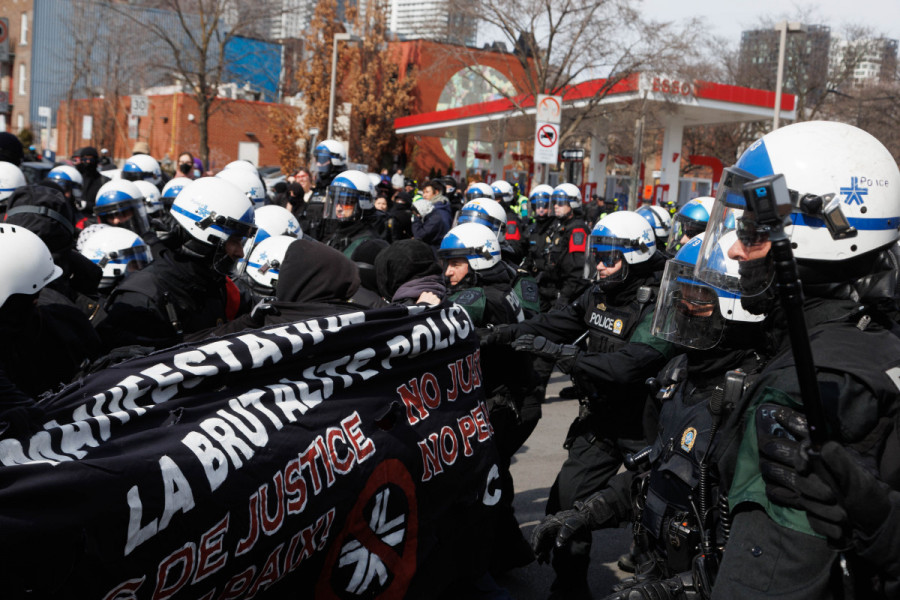
When Ki’ra Prentice attended a protest in downtown Montreal against the North Atlantic Treaty Organization (NATO) Parliamentary Assembly’s annual session in November 2024, she didn’t expect to end up with permanent physical injuries.
“It was all chill and fine at first,” she said. “We [were] holding a banner and marching.”
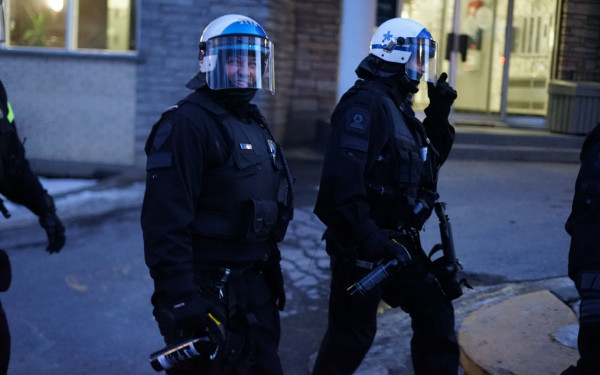
Prentice said that at a certain point, Montreal police (SPVM) shot tear gas in front of the demonstration while other officers in riot gear rushed the crowd from behind.
She recalled how she and her friends then moved away from the crowd to take a break on the corner of the street. As one of her friends was having trouble breathing due to the gas, Prentice said she turned around to get her water bottle out of her backpack when she was hit in the back of the head with a riot baton.
“[The officers] hit me in the back and continued to hit us a whole 400 metres as we went down the block,” she said.
According to Prentice, police continuously swiped at their legs while yelling at them to move. When her friends tried telling an officer that their friend couldn’t breathe, the officer allegedly said, “You don’t need to breathe to move.”
Prentice wound up with a broken pinky finger, muscle strain in her shoulder and back, and bruises on her forearms from shielding her head from baton hits.
Meanwhile, former Montreal mayor Valerie Plante defended the actions of police officers after protesters burned two vehicles and smashed windows at that same protest.
“I’m extremely proud of the police force we have here in Montreal. I want to thank them. The work will continue,” Plante said during a news conference a day after the protest.
Long-term effects of police violence
For demonstrators like Prentice, these statements shift the blame of police violence onto protesters.
“A question I got asked a lot was, ‘What did you do wrong?’” Prentice said. “I understand that sometimes there are demonstrations in which property damage happens, but how dare you draw [equivalence] between someone else breaking a window and my hand [being broken]?”
The SPVM’s 2024 annual report notes an around 45 per cent increase in the number of “crowd control services” used against demonstrations from 2019 to 2024.
Others have suffered psychological and emotional damage at the hands of law enforcement officers.
Léa Côté, who was granted a pseudonym to ensure her safety, attended a protest where police officers hit her in the sternum, and she received multiple cuts and bruises that left a scar on her back.
She says that the experience left her scared and that random events would remind her of what happened.
“People on bikes, not even police officers, heading towards me [would surprise me],” Côté said. “Anything that could hurt me and would come towards me would make my body react.”
Police violence is not just limited to actions against protesters.
Ted Rutland is an associate professor in the department of geography, planning, and environment at Concordia University, whose research specializes in ending police violence.
Rutland believes that there is a “state monopoly” on the use of violence and that the police system is the institution that is authorized to use said violence.
“[It] doesn’t mean that there’s violence in every interaction and every movement,” he said. “The police exist to defend a very unjust, oppressive social order.”
In 2024, a Quebec Superior Court judge ruled that racial profiling is a systemic problem in the SPVM, and that the victims of profiling deserve compensation.
According to Rutland, police violence extends beyond a police officer killing someone. It includes racial profiling and the forcible displacement of unhoused people, which both serve to perpetuate systemic inequalities.
“[The police are] constantly moving unhoused people from places that they’ve chosen to be because those are the best places for them,” Rutland said. “Whether that’s a park, a metro station or a tent, sometimes those interactions are directly violent.”
Defining Copaganda
Researchers like Rutland also believe that this structural violence is maintained thanks to the image the police occupy in culture.
Alec Karakatsanis, American civil rights lawyer and founder of the non-profit Civil Rights Corps, defines the term “copaganda” in his book Copaganda as “the system of government and news media propaganda that promotes mass incarceration, justifies the barbarities and profits that accompany it, and distorts our sense of what threatens us and what keeps us safe.”
Additionally, Rutland believes that there are many positive, glorifying images of the police in popular culture, from movies and TV series to children’s toys. These images, he said, portray the police profession as brave and noble.
“It all kind of normalizes the idea that we have very large institutions that specialize in violence, that we permit to carry out a lot of violence,” Rutland said.
“People on bikes, not even police officers, heading towards me [would surprise me]. Anything that could hurt me and would come towards me would make my body react.” — Léa Côté, protester
Holding institutions accountable
There are several options available to the general public to hold the police accountable for violent acts.
Individuals can send complaints to the Commissaire à la déontologie policière or the Bureau des enquêtes indépendantes (BEI). The BEI is a specialized police body that conducts independent investigations when someone is killed or severely injured during a police intervention. A report is then sent to the director of criminal and penal prosecutions, who decides whether or not to lay criminal charges.
Rutland said he believes that charges are often not laid against officers due to the relationship between the Crown and the police force.
“Almost all charges that [the Crown] lay, they’re working with the police except these rare cases where there’s a criminal charge against a cop,” Rutland said. “[The Crown is] a part of the culture of policing.”
While families of victims of police violence have had difficulties with the BEI, people can file civil suits against the city of Montreal for damages. Prentice, who says she didn’t find success with the BEI, is currently suing the city of Montreal for what was done to her and her friends.
The city’s new administration, Ensemble Montréal, campaigned on implementing a body-camera policy. Meanwhile, Montreal’s 2026 budget indicates that the SPVM’s budget will increase by around $36 million.
According to Rutland, a body-camera policy won’t change the violence used against people.
“It doesn’t reduce police violence, and it doesn’t result in the police being held accountable for the acts of violence to any greater extent,” he said.
Karakatsanis, who has spent over 10 years researching and studying body camera technology, said in an interview with the CBC that body cameras are "one of the most dangerous developments in modern policing." He explained that police can prevent the release of footage of an egregious incident while releasing other footage as propaganda.
Still, Rutland said he is hopeful that the current administration will not receive the same pressure to prove they are pro-police as Projet Montréal, a party historically known for its progressive agenda.
“Maybe they won’t get criticized as much,” Rutland said. “Therefore, maybe they might not take these extraordinary measures to prove to the public and the right-wing media that they’re pro-police.”
This article originally appeared in Volume 46, Issue 7, published January 13, 2026.