
Accountability starts with us
Montreal’s future depends on a generation that refuses to stay silent
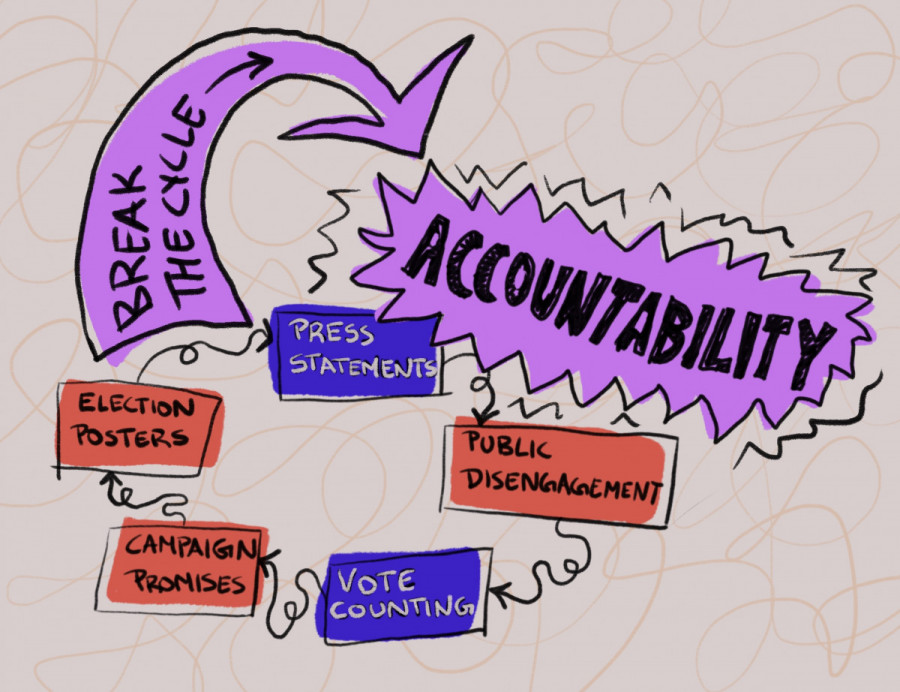
Montreal’s biggest challenge isn’t just housing, transit or tech—it’s accountability. And accountability doesn’t start in City Hall; it starts with who shows up.
Every few years, the city swells with election posters promising new bike lanes, verdant boroughs, affordable housing and technological innovation. Yet, by the time ballots are counted, promises wither away into press statements and commissions. The accountability crisis is not a matter of ideas—Montreal abounds with them—it is a matter of whether anyone lasts long enough to ensure they are delivered.
Look around: there are tents beneath overpasses, empty condo towers and transit corridors that never quite seem to benefit the communities that are most in need.
The expansion of the Réseau express métropolitain (REM) was a public transportation advance, and yet surveys show that the great swaths of working-class and student districts are still effectively disconnected. Smart-city initiatives are moving forward faster than consultation and governance frameworks can adapt, while green-space investments bypass the boroughs that need them most.
These failures are connected by one thread: nobody’s answerable when they happen.
But a lack of accountability isn’t only a government problem—it’s a civic one. In the last municipal election, voter turnout was less than 38 per cent, and was even lower among students and young adults, according to Élections Montréal. When most of us tune out, accountability becomes optional. Politicians learn that silence is safer than transparency.
That’s the culture this generation has to break.
We have the most at stake. Students are fighting to stay housed. Renters are one paycheque away from moving back home—or out of the city entirely.
Climate change is already reshaping our neighbourhoods: extreme heat in Parc-Extension, flooding in Pierrefonds and vanishing tree canopies in Ville-Marie. And the digital systems that increasingly govern daily life—from surveillance cameras to algorithmic policing—are being designed with little public oversight.
These aren’t isolated issues; they’re the architecture of everyday life. And the next city council will decide how livable—or how exclusionary—that architecture becomes.
So, what can we do?
First, vote. It sounds simple, but when few do so, it’s radical. Municipal politics may feel distant, yet they decide nearly everything: rent control enforcement, bus frequency, park maintenance, library hours and data governance. If young voters turned out even 5 or 10 per cent higher, entire borough councils would flip.
Second, demand transparency, not just representation. Ask candidates how they’ll measure success. Push for participatory budgeting, open-data dashboards and public progress reports. Accountability can’t exist if information doesn’t.
Third, get involved beyond the ballot box. Borough councils, youth committees and public consultations desperately need new voices—especially ones that understand intersectional equity, digital ethics and environmental justice. These are the frameworks our generation already studies and lives; applying them locally is how systems change.
Finally, remember that accountability is contagious. When students, tenants and young workers insist on it, institutions follow. Concordia University’s own sustainability and equity initiatives began because students refused to accept vague promises. The same energy can reshape this city if we carry it beyond campus and into the ballot box.
Montreal’s future doesn’t depend on perfect leaders—it depends on persistent citizens. Accountability isn’t a policy; it’s a habit, and habits spread. The next election will test whether we’re content with the old cycle of slogans and disappointment, or ready to build something steadier: a city that keeps its word.
Because housing, transit and technology will always be battlegrounds—but accountability is the fight that decides them all.
This article originally appeared in Volume 46, Issue 4, published October 21, 2025.



_600_375_90_s_c1.jpg)