A night with Gerry Adams
A Canadian documentary premiere turns into a night of memory, politics and community at Concordia
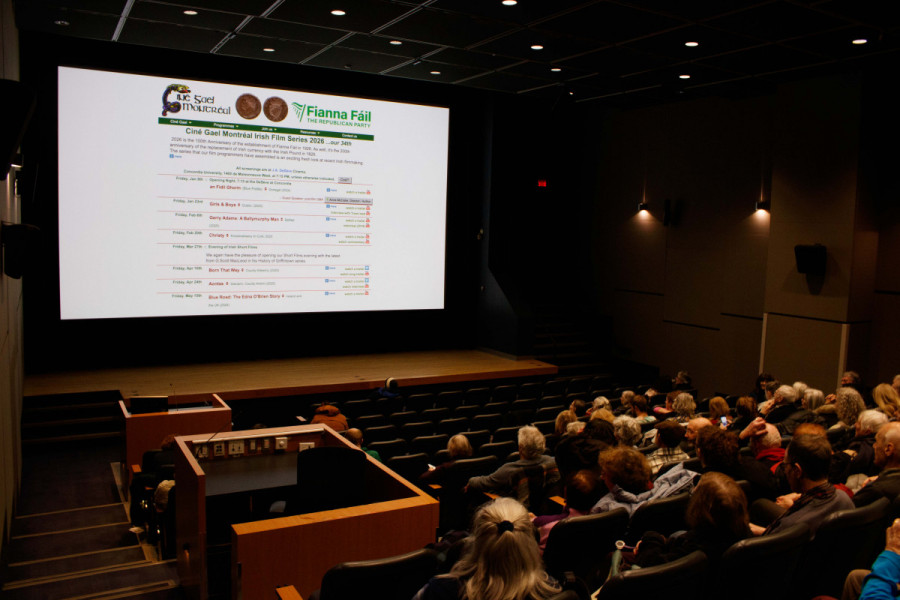
On Friday, Feb. 6, Ciné Gael hosted the Canadian premiere of Gerry Adams: A Ballymurphy Man at Concordia University’s J.A. DeSève Cinema.
The screening brought together a tight-knit audience of Irish community members, many of whom arrived early to socialize and reconnect ahead of the film.
The crowd was largely made up of older attendees, many with Irish heritage and long-standing ties to Ciné Gael’s programming. Several had previously met Gerry Adams and felt a personal connection to his activism.
Julie Guyot, an attendee with a deep interest in Irish history, said she first met Adams during a 1997 visit to Montreal tied to fundraising efforts around the peace agreement.
“I’m very in love with Irish history, so that’s why I’m here,” Guyot said.
Before the documentary began, Martina Branagan, chair of the Ciné Gael committee, opened with an introduction to the evening’s itinerary.
The film was then introduced by Gavin Foster, chair of Concordia’s Irish studies department, who contextualized Adams’ place within Irish political history. Foster described Adams as "among the most influential and consequential figures in the history of modern Irish nationalism."
“[He was] a very controversial and polarizing figure in Irish politics, certainly the most controversial figure since Éamon de Valera stepped aside in the 1970s,” Foster said.
Adams was born in 1948 in Ballymurphy, a Catholic district in West Belfast, and became involved in the Northern Ireland civil rights movement in the late 1960s.
He later led Sinn Féin and played a key role in the Northern Ireland peace process and the 1998 Good Friday Agreement, while consistently denying allegations of ever being a member of the Irish Republican Army.
Gerry Adams: A Ballymurphy Man follows Adams over five years as he reflects on Northern Ireland’s transition from conflict to peace. The documentary relies entirely on Adams’ narration, drawing on archival footage from The Troubles and centring his personal recollections, from political organizing to the emotional legacy of the hunger strikes.
Early in the documentary, Adams states that “politics is not worth anything unless it empowers the people,” a sentiment that recurs throughout the film. Notably, Adams serves as the film’s sole narrator, with no dissenting voices or direct challenges to his account.
The documentary concludes with a call for peace and reconciliation, prompting sustained applause from the audience.
Originally, a Zoom Q&A between Branagan and Trisha Ziff, the documentary’s director, was scheduled to take place after the screening. However, due to events in Ziff’s personal life, the discussion was pre-recorded the day before.
When asked what she hoped people would take away from the film, Ziff spoke about the long-standing public perception of Gerry Adams and the importance of questioning dominant narratives.
“I think there’s such a long history of vilification, of demonization of Gerry Adams,” Ziff said.
She added that the film is meant to encourage viewers to step back from those narratives and think more critically about the stories they are presented with.
“Not only is [it] important in relation to the story of Gerry Adams," Ziff said, "I think it’s important in the story of everything, the role of questioning the stories we are told, whatever they’re about, and why we are told them, and why those stories persist.”
Every spring, Ciné Gael, in collaboration with Concordia’s Irish studies department, organizes the largest annual Irish film series in North America. This year’s lineup includes Christy, a film about two struggling brothers in Cork, which airs on Feb. 20. It's followed by an evening of Irish short films on March 27.
Together, the screenings aim to create space for Irish cinema, history and community to come together beyond the screen.