The truth about working as a woman in nightlife
Women say sexual harassment is normalized across the industry in Montreal
Content warning: This article contains descriptions of sexual harassment and inappropriate sexual behaviour.
Melissa Pappas has clocked into work at various nightclubs and bars in Montreal for nearly two decades.
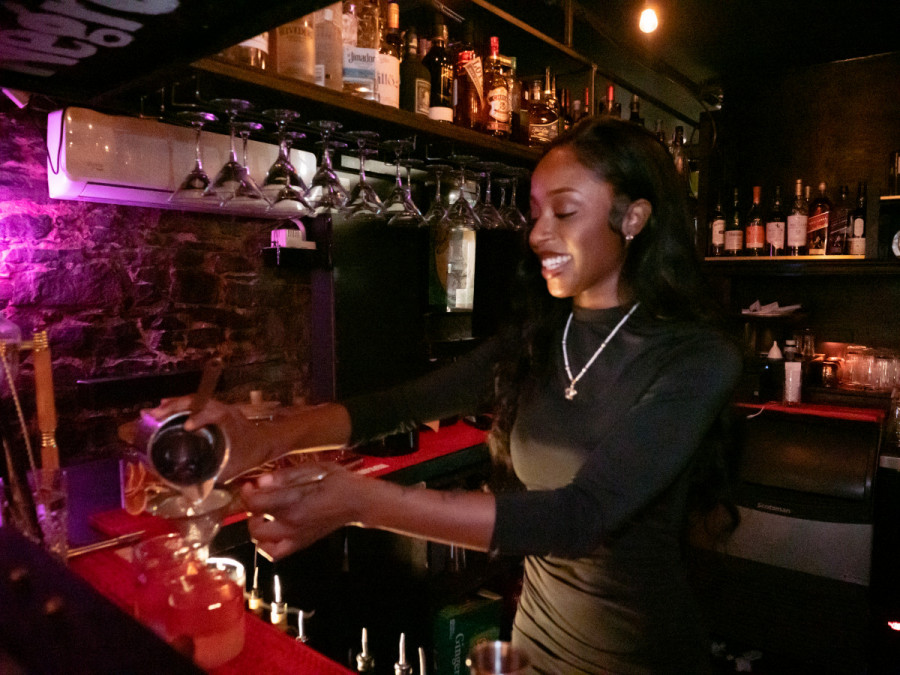
One Friday night, she’s dressed in all black as she shakes cocktails and pours shots until 4 a.m. for the drunken clients coming up to the bar. She’s friendly as she takes their order. She smiles and makes jokes in hopes that her cheery nature will bring her a hefty tip.
The “largely male clientele,” as she describes it, doesn't always make it easy for her.
“On one occasion, I had a regular male client call me a whore,” Pappas says. Stunned by the comment, she says she asked the male bar owner to have the customer kicked out. The owner refused.
Experiences like Pappas’s are common among women in Montreal’s nightlife industry since they constantly interact with customers, according to a 2020 Statistics Canada report.
The report found that women working in service and sales industries were most likely to experience inappropriate sexualized behaviours at work compared to women in most other industries. Women working rotating shifts, evening shifts or irregular schedules—typical in bars, nightclubs and strip clubs—reported higher rates of such experiences.
Male clients often act in threatening ways towards women because of the power difference between customer and employee, say Dr. Jill Poulston and master’s student Beth Waudby in a 2017 study from the International Journal of Culture, Tourism and Hospitality Research.
Poulston and Waudby found that respondents of their study felt that restaurants and bars are places where sexual behaviours are expected. The researchers found that sexualization of labour can lead to customers behaving sexually and generating harassment. Managers prioritize customer loyalty and expect women to expect sexual behaviours from customers, they say.
Public-facing industry
The 2020 Statistics Canada report “Workers’ experiences of inappropriate sexualized behaviours, sexual assault and gender-based discrimination in the Canadian provinces,” found that the public-facing nature of service occupations encourages harassment or demeaning behaviour from clients.
“There was one time when this guy was kind of stalking me, showing up at the bar all the time,” says Lola Bakel, an employee at Negroni Room and Buvette Pastek, “and after, showing up where I live.”
“In this profession, the minute you walk through the door, you’re an object. I think there is just kind of like an anything-goes mentality with clients where [consent] goes out the window. So it’s like you’re just consenting by being there and being a sex worker, in their brain.” — Margaux Fournier, stripper
The 2020 Statistics Canada study found that, of the female service and sales workers who had experienced inappropriate sexualized behaviour in the workplace, 53 per cent of them had at least one incident perpetrated by a customer.
Waudby and Poulston also found that managers sometimes require staff to wear clothing that accentuates their sex appeal to increase customer loyalty and spending.
“My friend was working at [a club on St. Laurent St.] and she would wear, you know, like dress pants and a nice top, something like what the men were wearing,” Bakel says. “And they put up a notice that women can only wear skirts or dresses, and they had to be a certain length.”
Waudby and Poulston report that managers’ desire for customer satisfaction can condone difficult behaviours from customers and restrict female employees’ ability to reject unwanted sexual behaviour. This rings true specifically in environments offering alcohol and anonymity, like bars, they say.
The researchers also found that female employees sometimes report feeling the need to act in a sexual manner at work to maintain customer satisfaction.
“I can honestly say that I have actively flirted, worn different clothing and behaved less like myself in the hopes of making a greater dollar—especially when I was younger,” Pappas says.
In a 2011 testimony entitled “Sexual Exploitation Industry Makes Both Victims and Victimizers,” Dr. Mary Anne Layden says that the sex industry normalizes the belief that women’s bodies are sex objects meant for male entertainment, which gives male customers a false sense of permission to cross sexual boundaries with female strippers. Layden says most strippers have been sexually harassed and that the activity of stripping produces violence.
“I've had people slide their hand under my underwear, like into my vagina,” says Margaux Fournier, a stripper at a club in the Plateau who was granted a pseudym for fear of professional repercussions.
A 2018 study conducted in Portland, Oregon by academic researcher, Harley J. Paulsen, and Dr. Ericka Kimball, found that 84 per cent of strippers reported “unwanted groping, rape, forced or coerced unwanted sexual acts.” The study also found that 63 per cent experienced verbal abuse, 59 per cent experienced harassment, and 53 per cent experienced physical assault.
“In this profession, the minute you walk through the door, you're an object,” Fournier says. “I think there is just kind of like an anything-goes mentality with clients where [consent] goes out the window. So it's like you're just consenting by being there and being a sex worker, in their brain.”
Power differentials
Power differences can further exarbate sexual harassment according to nightlife workers and researchers.
In a 2008 article from the SAGE Handbook of Organizational Behavior, Dr. Lilia Cortina and Dr. Jennifer L. Berdahl state, “Power inequality facilitates sexual harassment, and sexual harassment reinforces power inequality.”
According to Waudby and Poulston, power inequality in nightlife industries is linked to the economic power that customers have over workers’ tips.
“I understand you're paying your bill. That's cool,” Bakel says. “I'm still a human fucking being.”
The 2020 Statistics Canada study reported that workers may avoid reporting incidents to avoid losing tips.
“Sometimes I'm desperate enough for the money that I just, like, smile and keep going, stare at the wall, you know,” Fournier says.
Taking action
A 2023 report entitled “Sexual Harassment in the Hospitality, Gaming, and Airline Sectors in Canada,” by the Centre for Research and Education on Violence Against Women and Children (CREVAWC), found that hospitality workers particularly experience a lack of support from management.
“There are times where women will have issues with clients being inappropriate or touching them inappropriately, and management’s like, ‘Oh well, look at your outfit or you're just a pretty girl,’” Bakel says.
Pappas says sometimes, management is the problem.
“There were under-the-breath comments and sometimes direct comments about how [the female staff] all looked,” Pappas says about former employers.
Since managers are often the only avenue to report incidents of sexual harassment in these industries, harassment by both customers and managers can often go overlooked, according to the CREVAWC report.
“You can't always rely on them,” Fournier says. “It kind of depends on, like, what mood they're in and if they're going to stand up for you.”
Change has got to come
A 2022 economic report by the MTL 24/24 found that women hold 54 per cent of nightlife jobs in Quebec. However, women in management positions are scarce. A 2023 report from Diversity for Social Impact found that women account for only 34 per cent of leadership positions in the hospitality industry in Canada.
Bakel said she wants to see more female staff in managerial roles.
Research shows that more women in management reduces harassment in the workplace. In a 2021 paper titled “Does Board Gender Diversity Reduce Workplace Sexual Harassment?” researchers found that each additional female director is associated with a decrease of 20.71 per cent in the rate of sexual harassment. Fournier says the managers at the club she works at are all men.
“I think that's pretty much like every club, at least in Montreal,” she says.
“This is an industry predominantly held up by women, though not necessarily run by women,” Pappas says. “Kinda bullshit, if you ask me.”
This article originally appeared in Volume 46, Issue 3, published September 30, 2025.