
Student housing, a human right worth fighting for
How housing organizations are seeking to help tenants recognize their rights
Concordia University attracts students from across the country and the world who want to pursue higher education in Montreal. Finding housing in the city, however, remains an issue that continues to impact students’ lives.
The university offers residence at the Gray Nuns Building, Hingston Hall, and the Jesuit Residence, mostly reserved for graduate students. According to the Concordia website, on-campus housing can cost over $12,000.
With limited space and high costs, some students opt to play their hand in the housing market.
Rent in the city has increased by 71 per cent since 2019, according to Statistics Canada's quarterly rent statistics report published in June.This drastic cost increase has left many struggling to pay for housing and other basic needs.
Ela Piñero-Tabah is a second-year liberal arts student at Concordia. After her first year renting and a bad experience with a previous landlord, she felt a lot of pressure to find a decent apartment.
“It kind of felt like once you had a good enough choice, you kind of had to go for it because you wouldn’t find something better,” she said.
Her previous landlord made her pay a security deposit, even though it is illegal in Quebec for a landlord to require a tenant to pay a deposit. They can only request the first month’s rent when a tenant signs their lease.
According to Piñero-Tabah, the renting process can be extremely intimidating when you are unsure of your rights as a tenant.
The Concordia Student Union’s Off-Campus Housing and Job Resource Centre (HOJO) is a centre that provides education and housing information for students.
Ates Balsoy, an assistant at HOJO, first used the organization’s classified page to find students looking for roommates or lease transfers. He says that most students ask HOJO for help with lease transfers and cancellations and to refuse rent increases.
“There are a lot of landlords, especially in Montreal, who give really high and exaggerated amounts for rent increases,” Balsoy said.
Tenants can challenge rent increases through Quebec’s rental tribunal, the Tribunal administratif du logement (TAL), which provides guidelines on rent adjustments that landlords aren’t required to follow.
According to Adam Mongrain, director of housing policy at Vivre en Ville, one solution would be a public rent registry that would allow renters to contest large increases.
Vivre en Ville, a non-profit organization, created its own online rent registry in May 2023, which allows tenants to contest large rent increases.
Mongrain said he wants the Quebec government to take their project to facilitate the process.
“We can count on the government to have all the information it needs to make sure that all the information in the rental registry is available online,” Mongrain said.
For students like Piñero-Tabah, having access to resources remains crucial to eliminating the fears around finding housing.
“It can feel so overwhelming to go at that alone,” she said. “To protest the rise of my rent, am I really going to get into that and bring it to the government and to court?”
According to Mongrain, however, the government has shown no interest in running the rent registry.
“The government said, ‘We don’t need this because landlords already have to provide this information,’” he said. “So, a rental registry would be redundant with the law.”
“I think as tenants we also need to bargain together [and] build a mobilization effort to fight rent increases and affordability. Housing is not seen as a human right; it’s still seen as a commodity.” — Ates Balsoy, HOJO
On top of rising costs, a large number of tenants are not aware of their rights. Namely, eighty-four per cent of tenants in Montreal are not aware of section G of the Quebec lease, according to a 2024 poll conducted by Vivre en Ville. Under section G, a landlord must provide new tenants with a written notice of the lowest rent paid in the last 12 months.
Mongrain said he believes that this particularly affects students because of the prevalence of students living with roommates who sublet. According to him, the majority of these tenants do not know the previous rent because they have never seen the lease.
Additionally, the passage of Bill 31 in February 2024 effectively allows landlords to terminate a lease transfer for any reason.
“If [the Quebec government] wanted to make life easier for a student population, [they] would bring back the old terms for lease transfers,” Mongrain said.
Mongrain also proposed that the government give student housing providers different conditions, such as tax exemptions and exemptions from zoning bylaws, to build their projects.
In an increasingly unaffordable city, Balsoy said tenants must organize and apply pressure on the government to recognize housing as a human need, not a market-driven one.
“I think as tenants we also need to bargain together [and] build a mobilization effort to fight rent increases and affordability,” Balsoy said. “Housing is not seen as a human right; it’s still seen as a commodity.”
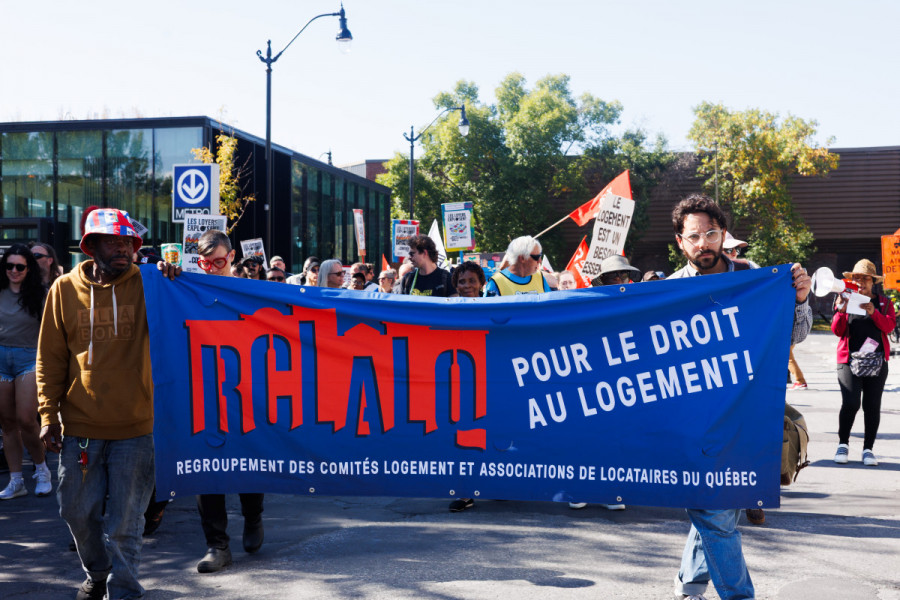
With costs on the rise, on Sept. 13, protesters gathered at Place-Saint-Henri Metro station for a demonstration organized by the Coalition of Housing Committees and Tenants Associations of Quebec (RCLALQ).
Attendees showed up to contest the rise in rent costs and recent modifications to the calculation of rent hikes by the previous housing minister, France-Élaine Duranceau.
Duranceau admitted in a memorandum obtained by Le Devoir that the modifications risk increasing rent prices for the most vulnerable tenants.
Noémie Beauvais works as a community organizer for RCLALQ. She said she hopes that the new housing minister, Sonia Bélanger, will be more sensitive to the issues faced by tenants.
According to Beauvais, the housing crisis targets students, as they generally work part-time and have to worry about school fees.
“What we are asking her to do is to completely withdraw the proposed regulation on rent setting and freeze rent increases for the next year,” Beauvais said.
Some organizers at the protest expressed that they aren’t hopeful that the situation will change.
“The former housing minister, who made terrible decisions regarding the situation of tenants, was [promoted],” said Carl Lafrenière, a community organizer for the Front d’action populaire en réaménagement urbain.
For demonstrators like Lafrenière, the government has sided with landlords.
“This clearly shows that it is not a question of person, but is really the vision of the CAQ (Coalition Avenir Québec),” Lafrenière said.
This article originally appeared in Volume 46, Issue 2, published September 16, 2025.