Strength through sumo
In Montreal’s only sumo club, strength looks different
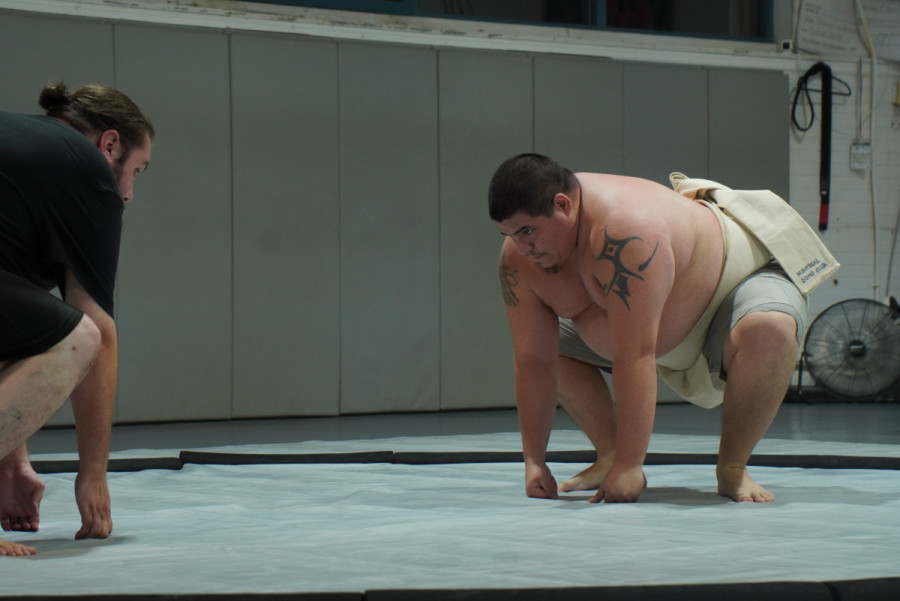
The sound of bodies colliding fills the room as night drapes over Montreal. Bare feet slap against the mats at HoMa BJJ headquarters in Hochelaga-Maisonneuve, where a circle of black foam marks the dohyō—the ring. Inside it, two men lean low, hands grazing the floor. Their muscles tense, breath steadying. When the signal comes, they clash.
From the sidelines, Agustin Gimenez watches closely, arms to his hips but eyes alert. The looming founder of the Montreal Sumo Club doesn’t shout orders. Instead, he gives a round of applause before stepping forward to aid with a fighter’s stance.
Founded in 2022, the Montreal Sumo Club meets every Friday at 7:30 p.m. to train and spar.
For Gimenez, this ring represents years of curiosity turned into commitment.
“I got into strength sports in my early 20s; powerlifting, a bit of strongman,” he said. “Then I went to Japan on honeymoon and saw my first sumo tournament. Ever since that day, I got hooked.”
Back in Montreal, there were no sumo clubs to join. So he made one.
It started modestly, with a Facebook post and a handful of friends from his judo gym.
“The very first day, I was surprised to see that many people,” Gimenez said.
They trained in a park for weeks before finding space inside HoMa BJJ’s facility, where they now practice every Friday.
Two years in, the club averages eight members: men and women of all sizes, most of them newcomers to the sport.
During class, Gimenez leads an intense warm-up of squats, lunges and stomps. Between sets, he checks in with members, offering brief corrections and light conversation. The room alternates between focused silence and bursts of laughter as the group moves through the drills.
Sumo, as Gimenez explained, isn’t just about mass; it’s about movement.
“You need to develop strength, speed and a wrestler’s brain,” he said. “It’s like a very fast game of chess with your opponent.”
That chess game soon fills the room with rhythm. Bodies thud, hands slap and the group cheers after each bout. The black foam circle, worn from friction, feels like the centre of something ancient and new all at once.
Sumo’s deep cultural roots stretch back centuries, but its Montreal chapter is still young.
According to Dr. Matthew Penney, a Concordia historian specializing in Japanese culture, amateur sumo abroad isn’t an imitation of the professional tradition; it’s a continuation of it. He sees local initiatives like Gimenez's as part of a wider cultural exchange that’s brought Japanese martial arts and traditions to cities worldwide.
“It has the potential to get more people interested in different cultures and cultural exchange,” Penney said.
Gimenez doesn’t claim to represent that heritage—he simply wants to make space for it. “You learn how to fight,” he said. “But you also learn about discipline, respect, and pushing yourself.”
Lucas Paladines, a molecular biology graduate from the Université de Sherbrooke, stands among the wrestlers catching their breath between rounds. His dark hair glistens with sweat as he laughs through his exhaustion.
“The beginning, that’s the hardest,” he said, referring to the club’s ritual of 100 squats. “It’s so hard, but so good. You feel really good about your legs afterward.”
Paladines only joined a few months ago after hearing about the club online. Before this, he’d trained in aikido and kobudō, but sumo felt different.
“Here you can be small, tall—whatever size you are—you can be in this class,” Paladines said. “It’s all acceptance. You can learn, you can be with each other. And it's always amazing.”
As the sparring begins again, the mats shake with energy. Sweat beads along forearms. The wrestlers grunt and dig their feet in, straining to push the other from the circle. When one finally tumbles out, applause replaces tension.
At its core, Gimenez’s project focuses as much on people as it does on sport.
“I see a lot of people who are curious, who never thought about doing sumo before,” he said. “When they heard about the club, they thought, ‘Wow, this is really unique.’ And those people usually stay because they’re open-minded.”
His approach, gentle but firm, fosters what one might call a soft strength. He encourages respect and camaraderie, a code that extends beyond the ring.
“You help them, they help you, and that’s how you get better,” Gimenez said. “It’s impossible to get better by yourself.”
That cooperative energy feels infectious. After practice, members linger, chatting and exchanging water bottles. All members stay behind to help roll up mats. Paladines says that shared effort keeps the group connected.
“It’s hard, but we do it together,” he added.
“I see a lot of people who are curious, who never thought about doing sumo before. When they heard about the club, they thought, ‘Wow, this is really unique.’ And those people usually stay because they’re open-minded.” — Agustin Gimenez
For Olivia Feng, a PhD candidate in kinesiology and physical education at McGill University, that “come as you are” spirit reflects a quiet revolution in how athletes see themselves.
“The environment plays a really big role in how athletes feel about themselves and about sport,” Feng said. “The people around them and the messages they send really matter.”
Feng studies body image and mental health in athletic spaces. In her view, inclusive clubs like Gimenez’s can disrupt old ideas about what athletes should look like.
“We’re starting to open up our definitions of what winning looks like,” she explained. “There’s more emphasis on winning well now; a more holistic idea of athlete well-being.”
Her words echo what happens weekly inside the dojo. There’s no scale, no talk of calories, no mention of weight classes—just movement, laughter and effort. In a sport often associated with mass, it’s not about size but about acceptance.
“I think the idea of 'come as you are' should be applied to sport all the time,” Feng said. “Everyone should be welcomed.”
Gimenez agreed. For him, the biggest victory comes in seeing people who once hesitated now thriving in a sport they’d never imagined trying.
“They all tell me the same thing,” he said with a grin. “That it’s really intense—and that they love it because it’s so much fun.”
By the time training ends, the black foam ring has frayed, and sweat pools across the mats. Members gather for a group photo, laughing through exhaustion.
“I think we’re doing pretty well,” Gimenez said. “Considering we’re the only sumo club in Quebec.”
It’s hard to argue with that.
This article originally appeared in Volume 46, Issue 4, published October 21, 2025.



4_600_375_90_s_c1.jpg)