Old school is the new house
How DJ Michael Terzian’s devotion to vinyl, house music’s roots and crowd-first curation keeps old sounds alive in Montreal
On a Saturday night at Sans Soleil, the music announces itself before the room does.
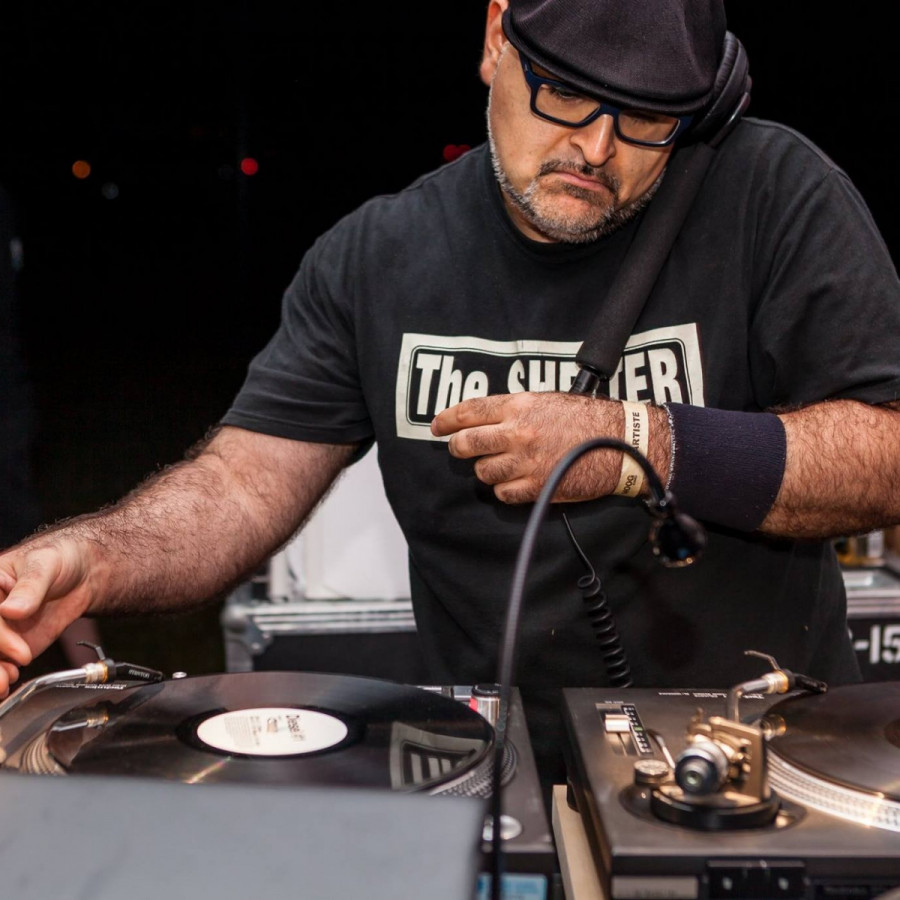
Descending into the basement, the steady thump of a four-on-the-floor house beat grows heavier with every step, filling the narrow stairwell before the dance floor comes into view. Inside the dim and tightly packed space, bodies move together as the DJ works patiently behind two turntables and a mixer.
Behind the decks stands Michael Terzian, a Montreal-based DJ formerly known as DJ Sinister, whose approach to house music is rooted in vinyl, musical history and an attentiveness to the crowd that feels increasingly rare.
Born and raised in Montreal and of Armenian descent, Terzian’s relationship to music began early, shaped by hip-hop and a deep curiosity about records as physical objects, long before house music entered his life. One of his earliest memories centres on a 12-inch copy of "Rapper’s Delight" by The Sugarhill Gang, which his older sister brought home.
“I would just sit in front of it, hooked, in deep silence, and just sucking it all in, playing the song over and over again until my parents told me to stop,” Terzian says.
That early pull toward underground music only deepened with time. What began with hip-hop became an obsession not just with the sound itself, but with how music was made, credited and circulated.
As a listener, Terzian paid as much attention to liner notes as he did to lyrics, drawn to producers’ names, record labels and the mechanics behind the music. That curiosity didn’t immediately lead to DJing, but it shaped his serious approach to music long before it became a public practice.
When he eventually began getting involved in radio and DJing in the mid-1990s, it didn’t come as a career pivot or a leap of faith, but as an extension of that same interest in process. At the time, Terzian was juggling multiple commitments, from studying to working to playing sets.
“Even my parents were like, 'What are you doing?'” Terzian recalls. “'Why are you playing records at a radio show from 2 to 7 a.m. on Sunday, a show that doesn't even pay you, it’s volunteer [work]?' They didn’t understand.”
That same commitment to learning and process continues to shape how he DJs today.
Unlike DJs who arrive with endless tracks stored on a USB, Terzian limits himself to what he can physically carry. He selects each record intentionally, drawn from years of listening, collecting and studying the music. The restriction helps him stay deliberately present, focused and accountable to the room.
“I’m not a vinyl DJ, I’m just a DJ. I simply have a preference for the vinyl medium, because it’s tangible, and I have a history and a memory with each record.” — Michael Terzian
For Terzian, that approach remains inseparable from his core practice.
“For me, it’s always about music first,” he says, brushing off trends that prioritize visibility over substance.
Rather than performing for cameras or chasing attention, Terzian sees his role as serving the dance floor by guiding energy, reading bodies and letting the music speak. The intimacy of the Sans Soleil basement is central to his sets. Instead of positioning himself as the focal point, he treats the DJ booth as a workspace rather than a stage.
“I come from a time when DJ booths were in the back corner, sometimes not even in front of the dancefloor, or perched up really high where you couldn’t even tell who was playing the music,” he says.
That perspective informs his critique of performance-driven DJ culture, where exaggerated gestures and constant self-promotion often take precedence over sound.
“In hip-hop culture, we used to call these people ‘biters.’ Those who jump on the bandwagon because it’s cool. Fakin' the funk and acting like they know,” Terzian says.
That care displays itself in the range of sounds he brings into a set. Drawing from deep house, Afro-Latin rhythms, raw techno and gospel and R&B-inspired vocals, his selections move fluidly between eras and genres without feeling scattered. The goal is never to impress, but to connect.
For many people in the room, this approach offers a different entry point into house music.
Max Mutombo, a regular at Sans Soleil, explains that the genre was not always part of his listening habits. Growing up on hip-hop and R&B, he began branching out during the pandemic, but it wasn’t until he spent time in Montreal’s underground spaces that house music truly clicked.
"Living in Ottawa, there wasn’t much of a scene, but once I started coming to Montreal and seeing that side of the city, I almost felt like I was in a TV show,” Mutombo says.
That sense of discovery is shared by Emily Albert, another regular attendee, who sees Terzian’s philosophy reflected in the music itself. In a city where DJ culture feels omnipresent, she describes his sets as a break from repetition.
“A lot of the music is kind of recycled, you know?” Albert says. “[DJs] will mix other house artists' music into their own mixes, and I’d be like, ‘Hmm, I already heard this before.’ Whereas Michael Terzian is unique."
For Terzian, vinyl is not a branding tool or a nostalgic flex, but a medium that shapes how he connects with music and with dancers. He carefully avoids romanticizing it, framing his preference as practical rather than ideological.
“This is the new generation coming up, and the new kids have placed great value on ‘music on vinyl,’ which is a great thing,” Terzian says. “But for me, I’m not a vinyl DJ, I’m just a DJ. I simply have a preference for the vinyl medium, because it’s tangible, and I have a history and a memory with each record."
In that sense, Terzian’s work revolves around revival rather than continuity. By grounding his sets in house music’s roots while remaining attentive to the present, he creates a space where old sounds feel alive rather than archived.
On a crowded dance floor, late into the night, “old school” becomes something shared—not preserved, but lived.
“Nothing makes me happier than a young 20-something kid who, when the lights come up, and the music stops, [...] sincerely thanks me for the music,” Terzian says. “That is my validation on this earth. That shit is sacred.”
This article originally appeared in Volume 46, Issue 7, published January 13, 2026.