Montreal artists brainstorm amid AI threats
As job opportunities dwindle, Montreal artists gather to share their experiences and discuss solutions
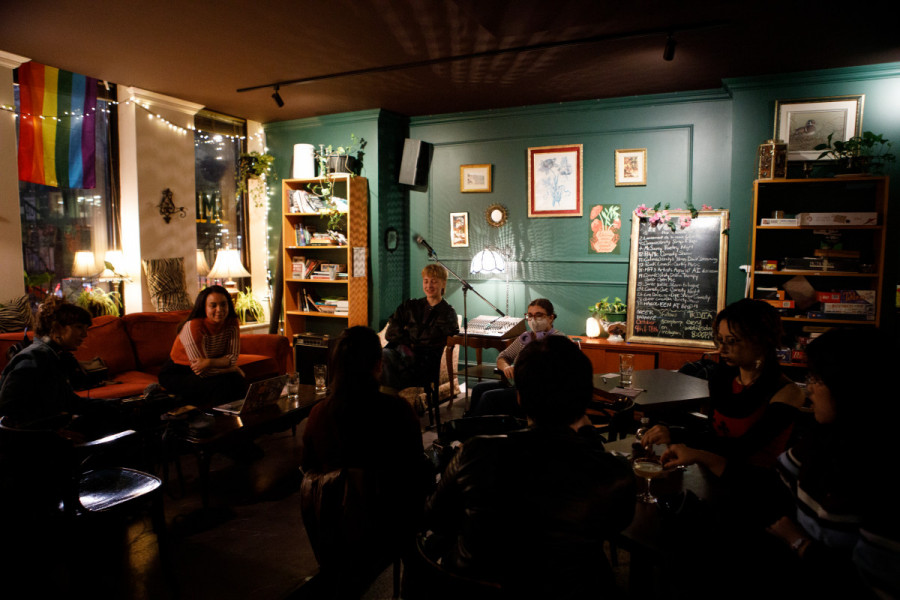
An open discussion surrounding the effects of AI on the art industry took place at Co-op Bar Milton-Parc on Oct. 18. The event, Artists Against AI, was organized by My Friend Frankie, a creative network connecting creators with local businesses and communities.
“A lot of artists in our network have expressed concern regarding AI infringing on the art industry," said Kelsey Nichole Brooks, event organizer and founder and creative director of My Friend Frankie.
“We see how AI is taking over opportunities that are meant for artists,” Brooks added.
The group first decided to initiate the event following the news that the Festival d'été de Québec (FEQ) decided to rely on generative AI for its marketing visuals in 2025. That same year, the FEQ was granted $1.75 million in funding from the Canadian government.
When describing her relationship to AI, Brooks expressed the inevitability of working alongside it in the future.
“I do believe that there is space for AI as we progress in the future,” Brooks said. “We will be increasingly reliant on technology; it’s just part of our lives, so adaptability is important. It’s about learning how to coexist with the technology.”
For Brooks, AI was created to liberate humans from mundane tasks. Brooks also advocates for education on ethical uses of AI in contrast with corporations using it solely for financial gain.
“When people unite together and express their concerns, I believe this is always the first step into making a difference,” Brooks said.
She hopes to eventually bring those concerns to legislation through petitions and boycotts.
The friendly, casual conversation started with describing issues on the devaluation of labour, plagiarism and environmental impacts, especially as artists specifically struggle amidst the current cost of living crisis. Many, including Brooks, advocated for a minimum living wage for artists.
Participants also pointed out that, while they still felt that it was easy for them to detect AI in most cases, new technology like the lifelike AI video generator Sora marked a tipping point for the use of AI in art.
“I can see it coming on the horizon,” said Sara Capanna, a local actor, singer and writer.
“We’re at a point where I think we just have to not engage with it. If you give a little bit, AI just kind of gets right in,” Capanna added.
Sie Douglas-Fish, an artist at an art-tech startup that specializes in mechanical reproduction of paintings with the intent to make art accessible, told attendees that they believe AI can push people to rethink creation and dissemination, and has potential for ethical uses.
At their workplace, Douglas-Fish develops software that trains AI to recognize and prevent fraud, creating new tools and strategies to authenticate original artworks. Early on in the discussion, the participants mentioned the detection of AI in writing as a starting point for regulations.
Attendees discussed the lack of transparency in AI policies, especially when it comes to the data used in training their models.
Johanna Gamarra, artist behind the creation of the event’s poster, noted that corporations unfairly profit off artists.
“It is pretty insulting that these corporations benefit from all the artwork posted online free of charge and make a buck off the backs of artists,” Gamarra said. “I fear that art as a career wasn’t well respected before, but now it’s worse.”
Concerns were also raised regarding the use of AI in politics with U.S. President Donald Trump sharing an AI-generated video of himself dropping feces on No King protesters on Oct. 18.
Many attendees also stressed the importance of engaging with their local community, actively revisiting traditional methods of curation, performance and self-publication. However, with reliance on AI on the rise, Capanna and others are worried that artists refusing to comply with new norms might be disadvantaged.
"I just hope that people are holding the line against AI as much as humanly possible," Capanna said.