I’m done pretending ‘slop’ is pointless
Absurd times call for absurd tools, and the FYP delivers
A shark in bright sneakers walks out of the sea to meet a bat-wielding anomaly. I catch myself asking, “Why? What’s the point—am I missing the joke?”
Maybe the answer is that there isn’t a single joke to get. And maybe that’s the point. We call it “brainrot,” but what if it’s the honest genre of the algorithmic age? Fast, contextless, intentionally absurd—it isn’t cultural decay so much as scrappy, unpolished art.
Slop mirrors our broken information world through rupture and play. We keep treating it as a symptom of boredom and decline. But what if this addictive, rotting content suggests something bigger? Symptoms point to conditions, and the condition here is absurdity: too much information, too little trust and everything sped up.
A century ago, Dadaists answered a senseless world with scissors and glue. They cut newspapers into nonsense, staged anti-art and challenged social norms. Today, the canvas is a vertical screen, and the tool is a timeline.
Dada met absurdity with scissors; slop meets it with speed. If art helps us see what’s real, the ugliest, silliest posts might be doing exactly that. The joke’s not on us—it’s for us.
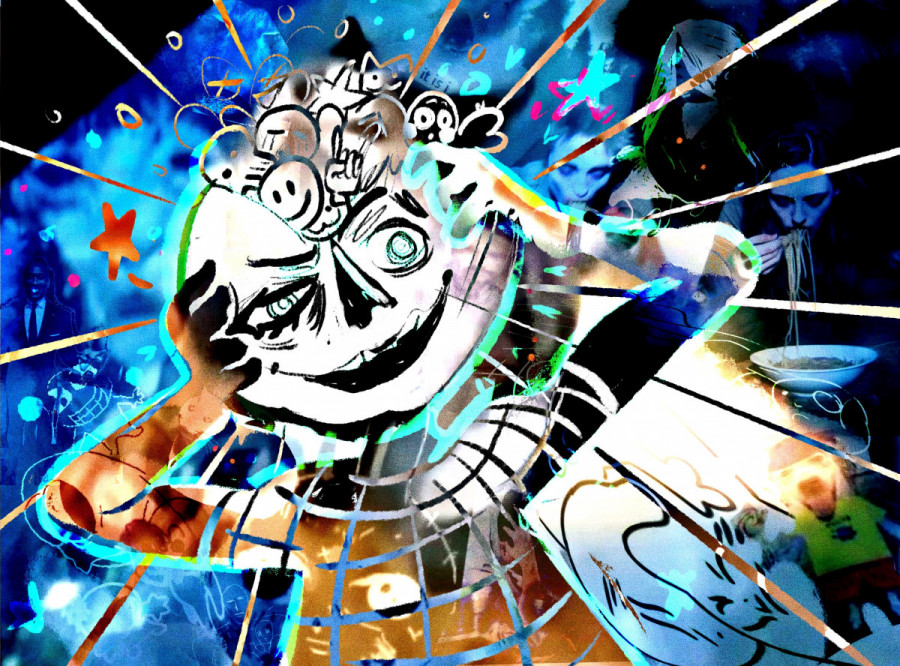
Looking closely, the techniques match: juxtaposition becomes split-screen chaos, chance becomes stitches and remixes, and spontaneity becomes a pass-it-on joke that belongs to everyone. A loop like “tralalero tralala” or “tung tung tung sahur” gets layered over Minecraft parkour, then a sitcom cutaway, then captions that spiral into in-jokes. It isn’t a puzzle with a correct answer but a chant—until nonsense coheres for a beat and a crowd laughs together.
Of course, not all slop is good. Some is spammy, cruel or noise, and some is just AI garbage. And yes, the attention economy rewards speed over care. But craft isn’t the only measure of value. Relief counts. Permission counts—the sense that you’re allowed to make something dumb and joyful without begging for polish. And community counts—the short-lived crowds that form around a chaotic, uncanny edit and then vanish on the next swipe.
The deeper tension is who gets to call it art. Dada proved rupture could be art; brainrot stress-tests that lesson at feed speed. The frame changed from curator to algorithm, plaque to caption, but the wager is the same. If art is a way of seeing the world as it is, slop might be our most honest mirror: fast, glitchy, collective and a little feral. It doesn’t pretend to fix the absurdity; it plays into it.
So, let’s name it without apologizing. Slop is the feed’s collage—roughcut and participatory. Keep your symphonies, novels and your careful films. But save space for the nine-second joke that isn’t a joke. In an age of too much and too fast, this is how we breathe together—one ridiculous stitch at a time.
This article originally appeared in Volume 46, Issue 2, published September 16, 2025.