Editorial: The only option is defunding, not reforming
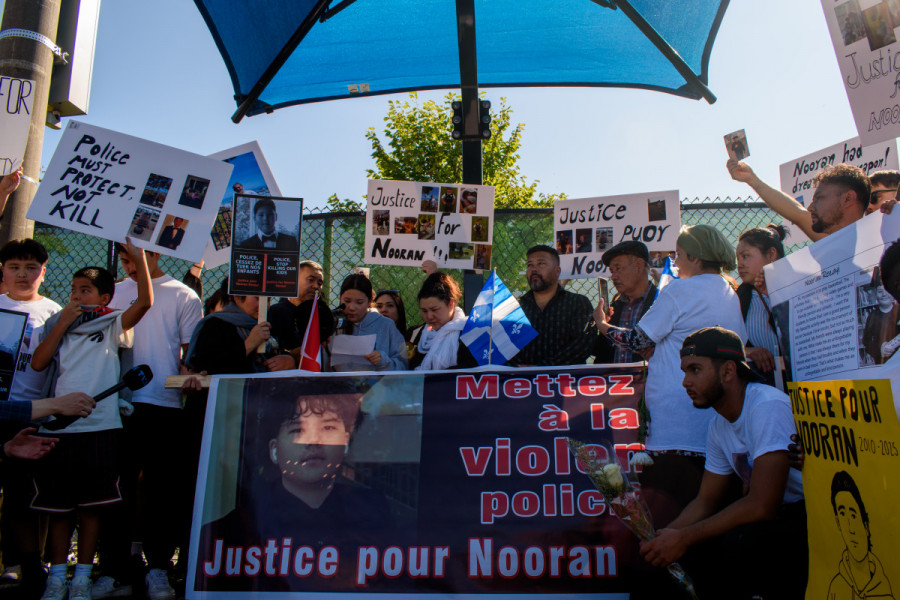
The Longueuil police murdered a child on Sept. 21. His name was Nooran Rezayi, and he was 15 years old.
Like almost all victims of police violence in Quebec, Rezayi wasn’t white, and he wasn’t armed. Quebec’s Bureau des enquêtes “indépendantes” (BEI) has said the only firearm seized at the scene belonged to the officer who shot him.
When police assume the task of investigating their own, the result is neither impartial nor credible. Since its inception in 2016, the BEI has opened hundreds of independent investigations (467 in total according to the watchdog itself)—yet only two of those have resulted in judicial proceedings (i.e. criminal charges) to date.
Critics, including the Ligue des droits et libertés, have long argued that the bureau’s independence has become compromised: many investigators are former police officers; its work leans on technical teams from other police forces; and its communications often repeat police accounts. In other words, “watchdog” is a generous euphemism.
The fact that community members insist that Rezayi’s killing was not a random incident, but rather the culmination of sustained harassment, makes this case exceptionally disturbing. A close friend of Rezayi shared in an interview that the officer who pulled the trigger had been targeting their group for months, issuing dubious tickets, racist insults and repeated abuse of authority. According to the friend, this officer singled out Rezayi repeatedly: “Every time he saw Nooran, he harassed him for no reason.”
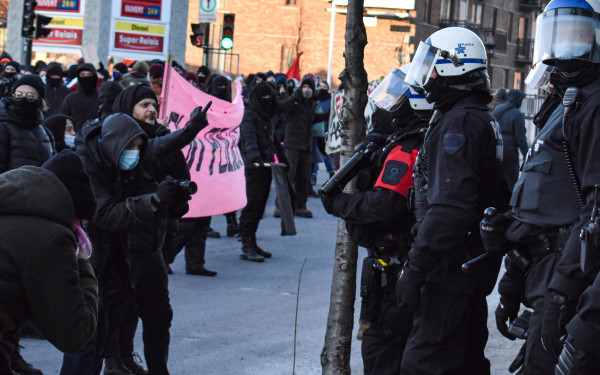
And this incident isn’t isolated. The killing comes after weeks of heavy-handed public-order policing around Montreal, including at the recent Rad Pride protest, where one of The Link’s editors watched SPVM gas a crowd—protesters and bystanders alike—including a 10-month-old and a five-year-old who were affected by the gas.
Local press freedom groups have also documented SPVM assaults and interferences with journalists at demonstrations this year. Ask anyone who has been to a heavily militarized protest and they’ll tell you: cops protect themselves, not innocent bystanders. Not even children.
Now, beyond all semblance of respect, police call for calm and respect after actions that displayed neither. Before a weekend vigil for Rezayi, Longueuil police warned of possible “violence” and deployed in numbers, in riot gear. Hundreds of civilians turned out peacefully to honour a boy whose family had explicitly asked for dignity.
Rezayi was shot dead in a residential street after officers responded to a call about youths and “weapons” (remember, the BEI later confirmed the only firearm found at the scene was the officer’s). The SPVM has since launched the standard “parallel” major-crimes inquiry that typically shadows BEI work.
Meanwhile, one 15-year-old was arrested on Sept. 24 for allegedly threatening a Longueuil officer online, and two other youths were arrested on intimidation-related allegations.
In March, The Link published an editorial denouncing police violence after SPVM officers assaulted our photo editor. Our editor was on assignment for The Link, had repeatedly identified themselves as media, and had explained multiple times that they had a press pass. Our editor was taking photos at Montreal’s annual anti-police brutality protest.
There is no safety under a system that treats racialized people as threats. Montreal’s own commissioned studies, as well as a 2024 court ruling, have found systemic racial profiling in the SPVM’s stops. Black, Indigenous and Arab residents—especially youth—are disproportionately targeted.
The situation is tragically predictable. We already know these problems are systemic. We know that so-called “bad apples” are actually the natural outcomes of current policy and resourcing.
The BEI’s structure fails on appearance and effect. Families are told to trust a process where a police chief’s report triggers the watchdog; many “independent” investigators are ex-police; investigators borrow forensic support from the SPVM/SQ; and the bureau’s public updates are often drawn from police narratives.
No amount of careful press-conferencing can restore confidence while the numbers—two charges out of 369 BEI serious-incident files, as reported in 2024—show obvious impunity.
If we are serious about reducing police violence, contact with armed officers must fall. That means defunding: reallocating money from police budgets to services that prevent harm and resolve conflict without guns.
Montreal’s police budget sits at roughly $824 million for 2025—up again from the previous year, despite chronic overspending tied to protest overtime. According to the Montreal Defund the Police Coalition, the SPVM’s budget has increased by nearly $200M since 2017. Meanwhile, over the same period, the community sector’s budget has remained stable.
The SPVM’s increase equals the entire budget allocated to the community sector. Just a fraction of that sum would benefit unarmed response, youth outreach and night-time mediation city-wide.
Defunding is a choice to invest in what actually keeps people safe: housing, mental-health care, youth programs and trusted community responders. It also means curbing the things that make police more dangerous, like riot gear, vague warnings that justify pre-emptive shows of force, and opaque disciplinary systems that return shooters to duty after a spell of “leave.”
What could accountability look like? Let’s start with a new watchdog: a civilian-only investigative agency with its own forensic capacity; statutory timelines; public reporting on delays; and the power to recommend charges and policy sanctions when forces obstruct.
We will also need disclosure by default: rapid release of all video and audio evidence to families and, with necessary redactions, to the public. We need to divert non-violent calls (youth disputes, wellness checks, neighbour conflicts) to unarmed teams and expand school-based mediation so that a reach into a rucksack isn’t read as a mortal threat.
Most of all, we need to cut the police budget and divert reinvestment to youth and crisis services.
There is no safety under a system that invests almost exclusively in force and then asks us to be calm when that force kills children. Police investigating police does not produce justice. The honest alternative: reduce the situations in which a racist, under-trained adult with a gun stands between a teenager and his future.
A child is dead. The system has proven it cannot police itself, cannot deliver justice and cannot protect our communities. The solution is clear: defund the police and put resources where they actually keep people safe.
This article originally appeared in Volume 46, Issue 3, published September 30, 2025.