Beyond the physical norm
Exploring beauty and diversity in The Body in Question?
_900_675_90.jpg)
Throughout history, the human body has shouldered the burden of beauty standards that exclude the vast diversity of shapes, sizes, and identities that make us unique.
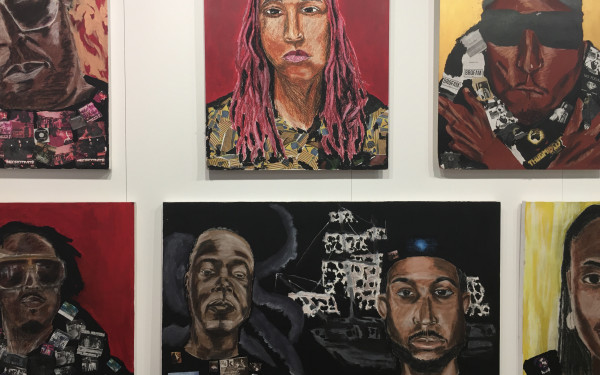
The exhibition The Body in Question? explores different understandings of the body, using photography, paintings and other mediums to showcase the vulnerability, beauty, and diversity of bodies that fall outside the norm.
The show displays nine artists from contrasting artistic and cultural backgrounds, offering a multitude of perspectives on the human body.
The curator, Professor Norman Cornett, highlights the need to move beyond binary concepts of the body and the makeshift boundaries of the human condition. As a doctor of religious studies, Cornett sees the exhibition as a transitional space between the material and spiritual realms.
“Everything we think, everything we wish, everything we feel, everything we desire, everything we wish for, it’s body-based,” Cornett said.
_900_2170_90.jpg)
Upon entering the gallery, visitors experience a sense of freedom. The exhibit frames the body as not just a subject, but a crucial part of identity, vulnerability and strength. From nude paintings and drawings to more mixed-media pieces, the show invites attendees to rethink learned narratives about the body.
The exhibit affirms that the body can not be merely defined by its size, or its sex, or its colour. Professor Cornett assembled artists whose work challenges and redefines the conventional view of the body. He sought out artists with a strong voice and something meaningful to say.
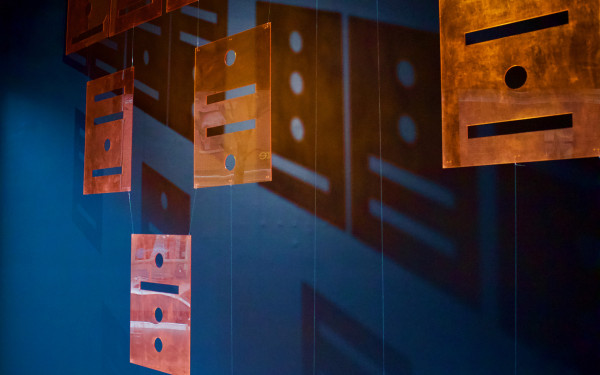
Among them is Won Ch. Kimetarx, a PhD student in architecture at Université du Québec à Montréal, who merges academic and artistic approaches. His work uses a complex symphony of lines, motifs, and buildings to represent the human body.
“I would like to translate the theme itself in the form of the human body in the architectural world and describe the world of architecture that is not dominated by modernist ideologies or spatial-centric,” Kimetarx said.
Other artists, such as Josée St-Amant, offer a different outlook on the human body. Her pieces explore the female nude body, the human form at its most original and authentic state. By removing the sexual associations often tied to nakedness, St-Amant invites the viewer to see the nude as divine and natural.
“I hope that the audience will bring home a new look on nudity, to be more comfortable, to realize that nudity can be ancestral, natural and beautiful,” St-Amant said.
Comparatively, Olivier Bonnet approaches the female body through bright colours and vintage-inspired imagery, drawing from his experiences growing up all over the world. Though rooted in a heterosexual male gaze, his work treats the female form not as something to dominate or conceal, but as something to celebrate.
While St-Amant’s pieces invite viewers to confront nudity as natural, and Bonnet invites viewers to appreciate the aesthetics of the female body, other artists in The Body in Question? take the body in opposite directions.
Through photography, Claude Gauthier captures the body in motion, using live models from around the world. His work explores the male body through the male gaze, bringing forward the intersection between the body and queerness.
Annouchka Gravel Galouchko and Lisette Duquette also delve into the male body, but from a female perspective. Duquette’s mixed-media works combine erotic drawings with bright colours and images, all superimposed with a computer. Together, their works allow for a complex take on male vulnerability.
_900_539_90.jpg)
The exhibition also features the work of artists like Soon Ja Park, Erik Nieminen and Lousnak, whose perspectives further enrich the conversation. The Body in Question? demonstrates that there is no singular way of seeing or understanding the human body.
For attendees such as Steven Loucks, this exhibition offered an unexpected entry point into art.
“When you first look at a piece, you might think it’s nothing. But if you study it, you can find something human inside it,” Loucks said. “That’s why galleries put seats—you need to sit and really look.”
The Body in Question? exhibition will run at Éclats 521 until Sept. 21, 2025.
This article originally appeared in Volume 46, Issue 2, published September 16, 2025.