Atwater Community Pantry brings mutual aid to the table
A small outdoor pantry in downtown Montreal seeks to help in a time of rising food and rent prices
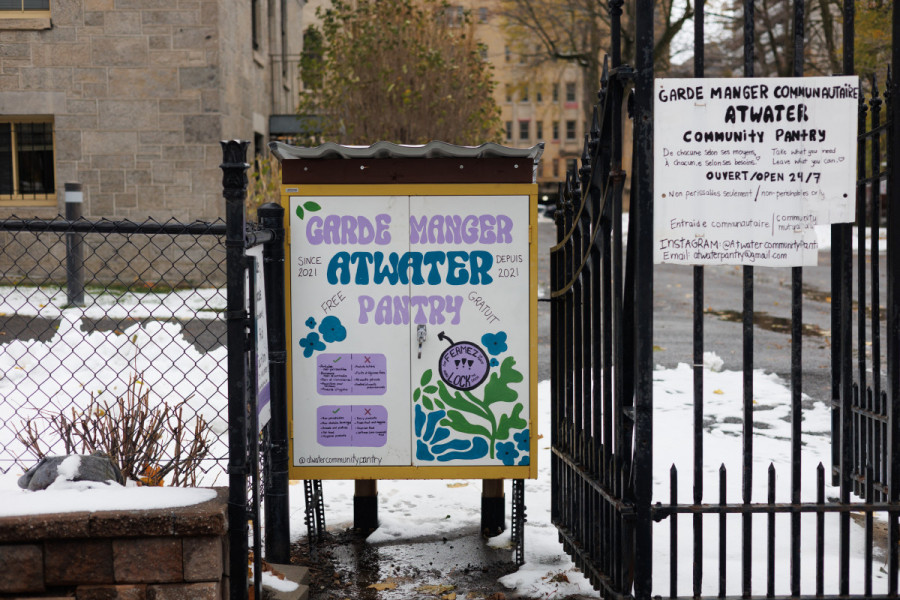
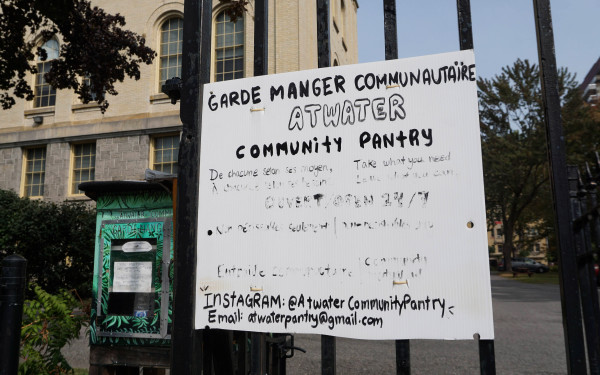
At the corner of Atwater and Lincoln Ave., a small wooden cabinet filled with canned goods, bread and toiletries stands as a symbol of solidarity.
At the corner of Atwater and Lincoln Ave., a small wooden cabinet filled with canned goods, bread and toiletries stands as a symbol of solidarity.
The Atwater Community Pantry, a 24/7 outdoor food-sharing space, is helping Montrealers cope with the city’s rising cost of living, one jar at a time.
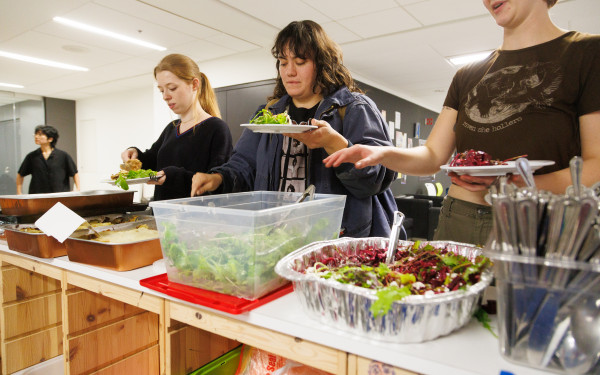
“It’s an outdoor space open to anyone, no matter their age or background,” said Juliana Saroop, a member of the Atwater Community Pantry team. “It’s really meant to be a sharing space where people can give and take whatever they need. We want to make sure there’s no stigma.”
The pantry first appeared five years ago as a student project proposal from Dawson College’s Green Earth Club. When the school didn’t approve their proposal, Saroop and a group of friends partnered with the Congregation of Notre Dame to host the pantry on its grounds.
“We were inspired by online mutual aid projects,” Saroop said. “We wanted something that reflected our values: community care, accessibility and fighting individualism.”
Today, the pantry is stocked with non-perishable food items, hygiene products and sometimes even pet food and spices. They are small luxuries that can make a difference, according to Saroop.
“A lot of people we serve are recently housed or barely holding on to their apartments. If your monthly check is $800 and rent costs the same, you’re left with nothing for food.” — David Chapman, Resilience Montreal
“We accept everything from canned food to soap,” Saroop said. “What we don’t take are expired goods or anything that might spoil in the winter.”
The project’s success reflects a growing need in Montreal. According to Statistics Canada, grocery prices have risen by more than 20 per cent in the last three years. Average rent for a two-bedroom apartment in the city has climbed to over $1,900 a month, an increase of around 70 per cent since 2019. As a result, food insecurity has become more widespread.
“Food has become our second biggest expense,” said David Chapman, executive director of Resilience Montreal, an Indigenous-led community centre located near Cabot Square.
Like the Atwater Community Pantry, Resilience Montreal seeks to offer food supplies to the community.
"We spend about $50,000 a month on food, and that’s after donations,” Chapman said. “Every month, more people show up asking for groceries.”
Still, Chapman explained that food insecurity affects far more than the unhoused population.
“A lot of people we serve are recently housed or barely holding on to their apartments,” he said. “If your monthly check is $800 and rent costs the same, you’re left with nothing for food.”
For Magnolia Rodriguez, a recent immigrant from Mexico and a user of the Atwater Community Pantry, that project has made all the difference.
“When I arrived in Montreal, everything was really hard,” Rodriguez said. “I have to pay for everything by myself: rent, food, clothes. Sometimes, when I don’t have enough for the month, I come here. It really helps me.”
Rodriguez added that she often gives back when she can.
“When I have extra, I bring things too. It’s not just about taking, it’s about helping each other,” she said. “I think many people don’t know about it yet, but it’s really helpful for the whole community.”
According to Saroop, the response to the pantry has been overwhelmingly positive.
“We’ve had people reach out with stories about how it helped them through tough times,” Saroop said. “There’s a mom who visits with her daughter every week and takes pictures in front of it. It’s sweet. It shows how much this small project means to people.”
Still, Saroop said that keeping the pantry running is not easy.
“Some of our partnerships have stopped donating, and many of us have moved away,” Saroop added. “We need more hands, more local businesses involved.”
In a city where prices keep climbing and resources are scarce, Saroop said that the Atwater Community Pantry stands as a reminder of what community care looks like.
“It’s a Band-Aid solution,” Saroop said, “but it’s a beautiful one. One that proves people are willing to look out for each other.”
This article originally appeared in Volume 46, Issue 6, published November 18, 2025.