Sobering up by chugging down
The rising popularity of non-alcoholic beverages and sober partying
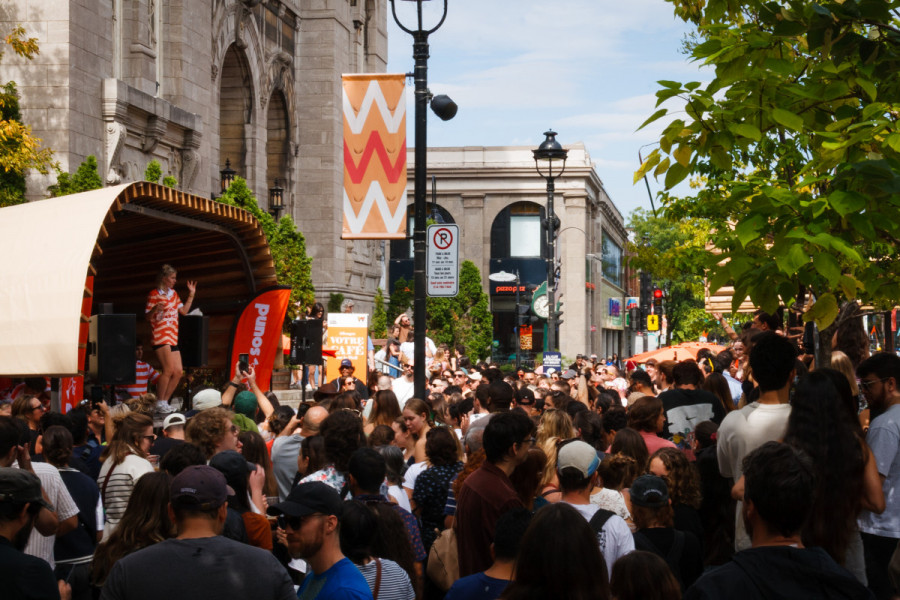
Last February, as the city was teetering back to normalcy after back-to-back historic snowstorms, Montrealers put on their dancing shoes and lined up along snowbanks on St. Laurent Blvd. on a Saturday morning.
Their destination, though, was not one of the many clubs that dot the commercial artery.
They were waiting to enter Cass Café, where DJ Bassil Sawaya was spinning groovy French house music. He wore a T-shirt with the words “cool people party at 11 AM” and a drawing of a croissant with dancing legs.
The usually calm and brightly lit café, a neighbourhood refuge for those seeking to get some work done, dimmed the lights and cleared the tables. People danced and shouted to beats, the ambience accentuated by hisses from milk frothers, which had morphed into fog machines. For uppers, there were espressos and croissants aplenty.
No alcoholic beverages were in sight.
That was the first of nine morning DJ sets that Lisa Rey, co-owner of the alcohol-free events company Croissound, has organized across Montreal and Paris. The biggest event at Le Central drew 1,500 people.
Inspired by TikTok videos of morning raves in Los Angeles, Rey and her boyfriend, Sawaya—both in their early 30s—decided to create a sober alternative to their erstwhile booze-filled, late-night party lifestyle.
“We're not drinkers anymore. We don't go out. So the alcohol is just less trendy, I feel, for our generation,” Rey said. “Everybody that is coming is saying that you don't even need to drink. The energy is so high.”
While the majority of guests at Rey’s events are between the ages of 25 and 35, they attract everyone from kids to grandparents and are a hit, particularly among sober individuals.
“[Sober people] appreciate that they have a party where the people around them are not drinking, so they don't feel alone,” Rey said.
Croissound represents one of many innovations—events, spaces and dealcoholized drinks—that are gaining popularity across the country among sober people and those seeking a different relationship with alcohol.
Looking to the West Coast, Angela Hansen founded Mocktails, a Vancouver-based “alcohol-free liquor store” last year, based on her own experience with alcohol. After getting sober two years ago, Hansen, who likes hosting parties, looked for alternatives to her favourite drinks.
While she discovered great products, Hansen realized there was no single place to shop for mocktail ingredients catering to people like her.
Despite initial skepticism from landlords and investors, Mocktails became an instant success.
“We opened our doors and there was a flood of people, there was a ton of media attention,” Hansen said. “It really was that story of ‘build and they will come.’”
Over 500 products line the physical and online store shelves of Mocktails.
From local beers, wines and spirits with names like Abstinence, Dr. Zero Zero, AmarNo, Free Spirits, Monday Mezcal, the variety is a far cry from the early days of sugary or fruity mocktails or the one non-alcoholic beer found at the end of a menu in bars.
A NielsenIQ study showed that the non-alcoholic beverage market grew by 24 per cent between June 2023 and June 2024 in Canada. Another NIQ study showed that alcohol sales declined by 0.8 per cent in 2024 compared to the previous year.
Jordan LeBel, a professor at the John Molson School of Business who specializes in food and beverage marketing, said that two major factors came together to fuel the phenomenon.
“[Gen Z] had a very different attitude towards health and how alcohol consumption fit into their worldview and their definition of health,” LeBel said. “They were also a little bit more adventurous and explorers in terms of seeking out different flavours, unusual flavour combinations.”
About a decade and a half ago, when members of Gen Z first came of age, they consumed less alcohol than previous generations (although recent NIQ research shows a shift).
In addition, wider social media trends like “Dry January” and “Sober October” showed that people consumed less alcohol by choice. LeBel added that, starting with millennials, the preference for locally sourced products increased.
LeBel said the industry caught on to these changing consumer preferences and developed new products.
“Now distillers have figured out, ‘Oh gee, people like local stuff. All right, so let's use herbs and fruits and things from Quebec to flavour gins or vodka or what have you, and have something uniquely local in the hope of seducing consumers,’” LeBel said.
Both distillers and flavour manufacturers like International Flavors & Fragrance are also increasingly using technology like AI to digest large datasets on consumer preferences to create new permutations and combinations of flavour mixes, LeBel explained.
All these innovations help create new and sophisticated non-alcoholic versions close to the real deal, which then find purchase among consumers.
“You look at mocktails [now], they're a little bit more complex and interesting in terms of the flavour, the drinking experience they provide,” LeBel said. “So, of course, that has turned on more people to this.”
From a marketing and distribution perspective, too, companies started to dedicate more shelf space to non- and low-alcoholic drinks.
For example, Croissound founder Rey recently signed a partnership with the Société des alcools du Québec (SAQ), the Quebec government-owned liquor store chain, to promote all non-alcoholic offerings at their events.
Emerson Pereira, a cocktail bartender who works at Pub Saint-Pierre in Old Montreal, said he added a non-alcoholic Negroni to the menu at the behest of one of his amaro suppliers who launched a non-alcoholic version of the spirit.
While the drink has been a hit ever since the bar introduced it, Pereira felt its popularity could rise even further if the prices came down. Right now, the bar prices the mocktail just a couple of dollars below the classic Negroni, even though the regular and dealcoholized bottles of spirits cost the same, around $30-35 apiece.
“We cannot charge the same because I'll be thinking I'm ripping someone off if they have a Negroni with alcohol and one non-alcoholic,” Pereira said. “I'll be damned the day that I'm gonna sell them for the same price.”
LeBel said he was unsure to what extent the prices of dealcoholized spirits might affect the growth of the industry. He added that smaller distillers who produce over two-thirds of the dealcoholized spirits might lose the ability to reduce prices if they don’t sell a high enough volume needed to achieve economies of scale.
In addition to the relatively low volume of dealcoholized spirits, Hansen pointed to the production process itself as the source of the high costs. But she doesn’t see that as a deterrent to customers.
“You have to bring everything to the alcohol state, and now you have to remove that alcohol. So that's a whole other process that costs,” Hansen said. “Once you explain that to the customer, they completely understand.”
Hansen said that the nascent industry is seeing rapid growth as more people discover the products and figure out how they fit into their lifestyle.
“It's just life changing for some people,” she said. “They can now enjoy something with their friends and they don't feel like they have to have the alcohol included.”
This article originally appeared in Volume 46, Issue 2, published September 16, 2025.