Le Cypher X: The city in real time
The weekly jam thrives on openness, trust and risk, bringing generations of artists together in one room
_900_600_90.jpg)
On Thursday nights at O Patro Vys, the music begins without a setlist, but always with purpose.
“A good jam sounds like a song and a bad jam sounds like a jam,” founder and bandleader Vincent Stephen-Ong says.
It’s both a mantra and a challenge, one that has carried the collective through more than a decade of weekly sessions.
Le Cypher X started at Le Belmont in 2014 but took shape at the now-closed Le Bleury bar à vinyle in 2015, before eventually moving to its current home on Mont-Royal.
Stephen-Ong describes the jam as a space that balances openness with musical discipline. Rather than exclusivity, the jam focuses on creating an environment where musicians can thrive together.
“We want to create a space where people are listening, where everyone amplifies each other,” he says. “It’s not just about chops. It’s about serving the music.”
Stephen-Ong is a saxophonist and keyboard player, as well as a freelancer, content creator and performer who has worked with countless groups across Montreal. Alongside performing, he also helped lead workshops with Kalmunity, an improvised collective that blended styles like hip hop, soul, reggae and Afrobeat.
In those sessions, he posed a multitude of questions: How do we do what we do? What are our goals, and how do we get out of problem areas when the music breaks down? That process pushed him to think more deeply about the challenges of improvised music and the strategies needed to turn raw, unpredictable moments into something cohesive.
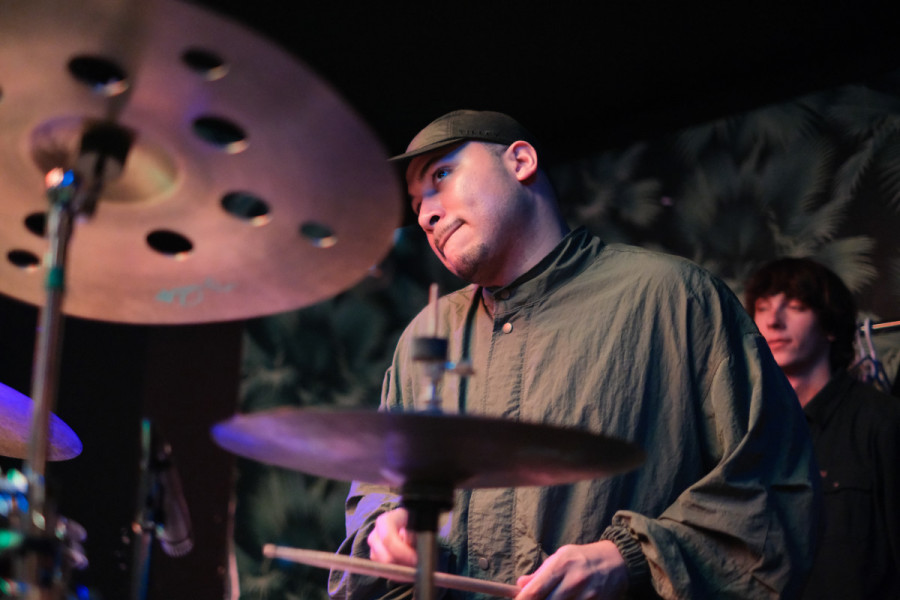
For drummer Shayne Assouline, Cypher became the place where persistence met mentorship. His introduction was humbling, and he jokingly admitted his first jam was a mess.
“I really did not do well, like I did such a bad job,” Assouline says.
But instead of shutting the door, Stephen-Ong guided him.
“He’s very approachable, and he’ll tell you what you need to hear, the things a lot of people won’t say, but he does it in a way where you know he cares,” Assouline says.
Over time, he practiced harder, made connections, and learned by watching players who inspired him to keep going.
“My name went up the list, and now I’m beyond the list,” Assouline adds.
Looking back, Assouline credits Le Cypher with shaping his path.
“If I had never gone to Cypher, I would have never started my own jam,” he says. “I built my career from being seen there and from playing with these guys all the time.”
That jam, Growve at Turbo Haüs, is now a weekly fixture he runs with Marcus Dillon, one of the collective’s vocalists and MCs, and another Cypher regular, Shem Gordon.
For Dillon, the jam represents both stage and classroom, as music didn’t arrive through formal training but through the love of language.
“I’ve always been fascinated with the good use of lyricism, timing, double entendre and rhetoric. I’ve always loved good words,” Dillon says.
Dillon recalls looping rapper Nas's verses on an MP3 player and rewriting them line for line, sharpening his craft in private before stepping into public.
When he first came to Le Cypher, he immediately felt the impact of the lessons.
“I would want to rap so bad that I would get on stage and grab the mic and confuse the whole band. I had no idea what I was doing,” Dillon says.
Years later, the same bandleader who tapped him on the shoulder to wait his turn asked him to host.
“I guess he thought I was a good MC,” Dillon adds. “He saw that I could hold the idea together and help it move forward.”
That mix of risk and trust defines the night. Sometimes the sound is seamless; sometimes it frays.
For Dillon, what matters most is the space created for whoever’s ready.
“If you’re in the front of the crowd and you feel like you could be attached to this song—let me know, and I’ll get you on stage as soon as musically feasible,” Dillon says.
That willingness to give the mic to whoever feels ready connects directly to how Le Cypher X began.
“A lot of it came from just being at house parties with other musicians,” Stephen-Ong says. “That’s the energy I wanted [...] putting different talented people together can lead to something unexpected.”
A verse might fall flat, a beat might stumble, but the chance that it all clicks and that a song takes shape in the moment makes the night worth it.
Stephen-Ong’s projects have always pushed for that balance between precision and play.
Alongside Le Cypher X, he leads the Urban Science Brass Band, a New Orleans-style ensemble that brings hip hop into the streets with horns, percussion and MCs. Both projects reflect the same instinct: to make music that feels alive, accessible and communal.
“At the core, what I hope for is really simple,” Stephen-Ong says. “That you come, and you have fun. Maybe you meet someone, maybe you take something positive with you, even if it’s the only time you ever come. That’s it.”
Assouline urges jammers to lean into discomfort and surround themselves with people who push them forward.
“Being good is really easy, but getting good is kind of hard—and we should get better at getting good,” Assouline says.
Cypher, he says, is the only space where, no matter your level, there’s going to be someone else there who will inspire you.
“Everyone wants to be there to kind of experience the same thing as you, so there’s something that connects you and that other person across the room that has a whole different thing going on,” Assouline adds.
The jam runs on community as much as it does on sound. Week after week, strangers become collaborators, and collaborators become friends.
Stephen-Ong often talks about the generational side of it: how veteran players share the stage with newcomers, and how each group pushes the other to grow.
Le Cypher X exists in that balance of improvisation and structure, risk and reward, chaos and cohesion. For Stephen-Ong, it’s about setting a standard that lifts Montreal’s jam culture while keeping it open to anyone ready to take a chance.
That same energy carries to the crowd.
“Le Cypher X makes Montreal feel small in the best way,” attendee Luke Savoie-Lopez says. “You realize half the city’s talent is right here, just waiting for a moment to show their skills.”
Or as Dillon puts it, “Your neighbours are crazy with it. And you probably didn’t even know.”
This article originally appeared in Volume 46, Issue 1, published September 2, 2025.