
Concordia University looks beyond U.S. suppliers amid tariff war
Concordia shifts its suppliers and travel policy as Canada-U.S. tensions hit campus operations
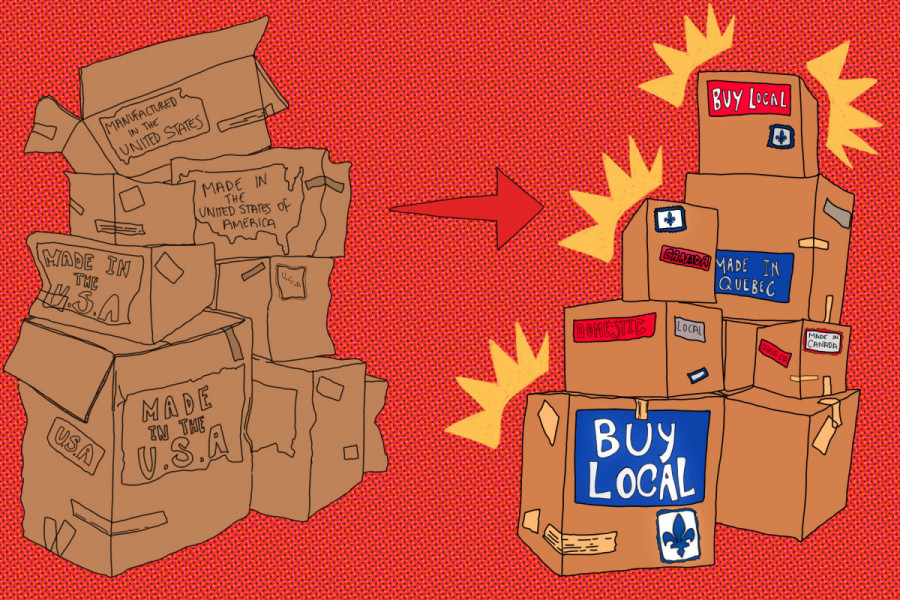
Concordia University updated its procurement practices to shift away from U.S. suppliers in response to the ongoing U.S.-Canada trade war, according to an access to information (ATI) request.
From advancing purchases and prioritizing local and non-U.S. suppliers to negotiating with vendors, the documents obtained by The Link showed that the university took several measures to avoid future tariff-related price hikes and to comply with the Quebec government’s countermeasures.
“We are implementing a number of measures to reduce awarding contracts to U.S. firms,” Caroline Bogner, senior director of procurement services, wrote in response to a question about what impact tariffs would have on Concordia, from corporate risk manager Rita Li, in April.
“It would be very difficult to do an overarching analysis on potential financial impact on us at this time,” Bogner added.
Concordia spokesperson Julie Fortier said in an email that the university expected a reduction in procurement from American companies, but noted that the changes would not have a major impact on academics or campus life.
“We only purchased [4.76 per cent] of goods from the U.S. even before discussions around tariffs began,” Fortier said. “So, we do not foresee any major impact.”
Last fiscal year (May 1, 2024, to April 30, 2025), Concordia spent about $10 million on U.S. suppliers and on travel expenses to the U.S., according to Denis Cossette, the university’s chief financial officer.
About 90 per cent of the amount went towards goods and services, including about a million apiece on library collections and research databases, lab equipment, software and licenses, as well as advertisements for “publicity, exposure, visibility,” according to the ATI.
The remainder of $1 million relates to travel expenses for conferences and research activities.
Economics professor Moshe Lander said that the uncertainty introduced by U.S. President Donald Trump’s flip-flopping tariff policy since taking office in January posed challenges to organizations when making long-term procurement commitments.
With changing tariff rates and price hikes, businesses faced uncertainty about signing contracts or spending more resources watching for the best deal.
“You might be stuck with a contract that says, ‘Sorry, you have to buy from us for the next year, two years, five years, at an agreed-upon price. Too bad [for] you,’” Lander said.
At Concordia, university officials also acted to place orders within a few days to a couple of weeks to avoid price hikes or renewing contracts ahead of time, anticipating a price increase.
Lander said that advancing purchases was a strategy taken by businesses when faced with a potential price rise or weakening currency.
“We've seen it in the GDP data that when Trump was imposing various deadlines, [we] would see this front loading of business where everybody would try and race to beat whatever the deadline was to make sure that it wasn't going to be subject to tariffs or disruptions,” he said.
The university officials also faced uncertainty on whether tariffs applied to certain goods.
In an email exchange with a redacted source, Helen McDonald, senior buyer at Concordia’s procurement services department, questioned why the reseller’s price was higher.
“There are no counter-tariffs on this type of equipment that would affect price - please tell me if you have evidence that any tariff would be in effect?” McDonald wrote.
In another instance, McDonald received a five-day deadline to send a purchase order to the vendor.
“I should normally be able to do this quickly, it's just the approvals that can get delayed and overnight refreshes,” she wrote.
Since January, Trump has imposed and paused tariffs or changed the rates several times, which the Canadian government has criticized as a violation of the Canada-U.S.-Mexico free trade agreement (CUSMA) signed during his first term.
Last Friday, a U.S. appeals court ruled that most of Trump’s tariffs were illegal, adding to the uncertainty.
The Canadian government, for its part, has backed away from retaliatory tariffs against the U.S. tariffs.
In August, the Carney government dropped some of the retaliatory tariffs on non-CUSMA-compliant goods in the hopes of advancing trade negotiations. In July, the government also scrapped the digital services tax after Trump ended trade talks abruptly.
However, Lander said that the CUSMA free trade regime still covers the vast majority of goods and services, and therefore is exempt from tariffs.
“I don't think that it's having much of an impact on Canadian consumers, of which Concordia is one, in part, because there's just no tariffs on a lot of stuff,” Lander said.
Apart from counter-tariffs, federal and provincial governments have also modified their procurement rules for public organizations.
For instance, in March, the Quebec government announced a slew of measures requiring public institutions like Concordia to change how they purchase goods and services.
The university updated its procurement policy, Lignes de conduite, following these to give preference to Montreal- and Quebec-based companies in procurement.
“As per a new government directive, we are also implementing a penalty on U.S. bidders who bid on our public calls for tenders for certain types of procurements, of between 10 to 25 (per cent) if a bidder has a U.S. address,” Bogner wrote in another email exchange shared in response to the ATI.
Under these rules, a product manufactured in the U.S. would not be subject to penalties if imported and sold by a Canadian or Quebec vendor, according to Fortier.
“A Quebec/Canada-based reseller of an American manufactured good is considered a Quebec/Canada vendor, not a U.S. vendor,” she said in an email to The Link.
Fortier also said the university would continue to procure some specialized research equipment from the U.S., nonetheless.
“Some goods or services can only be obtained from certain U.S. vendors, especially in a research environment,” she added.
This article originally appeared in Volume 46, Issue 1, published September 2, 2025.





_600_375_90_s_c1.jpg)