Inceldom, extremism, and mainstream misogyny
Incel ideas have been gaining more traction, inciting violence that makes them impossible to ignore
Content warning: violence, racism, misogyny.
A 13-year-old boy, grinning from ear to ear, holds his new phone in his hand and downloads all the apps he’s been seeing on his friend’s devices.
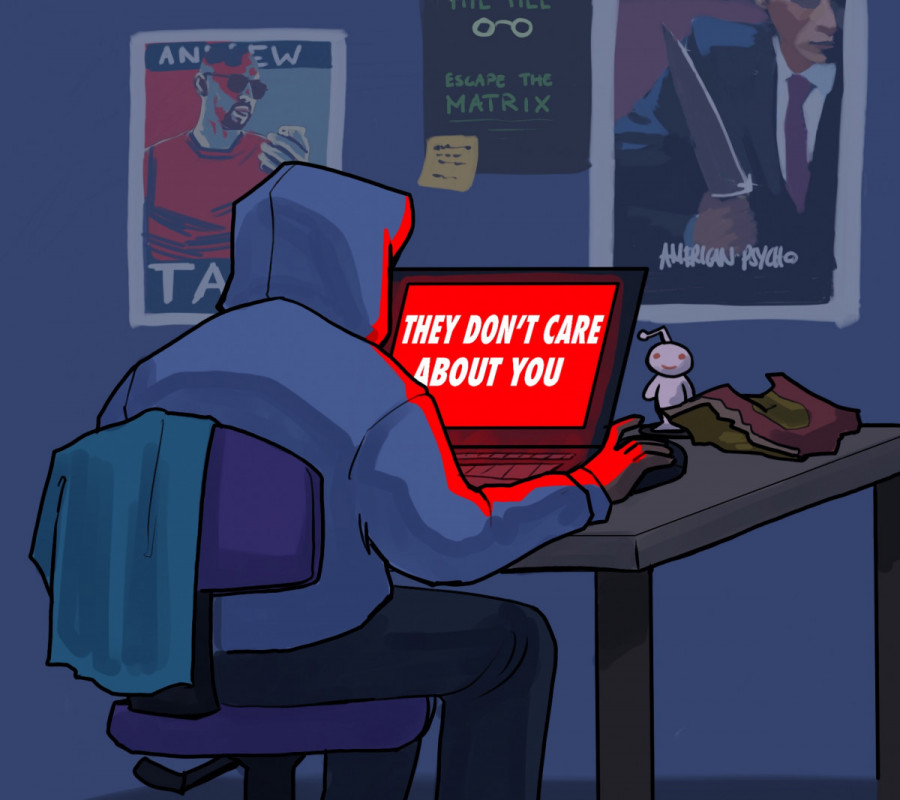
At first, the algorithm doesn’t know what the boy wants, but at some point he and his friends start liking videos promoting self-improvement, going to the gym and how to get girls. He starts to echo views from creators such as Andrew Tate.
These internet personalities are telling him that it’s not his fault girls don’t like him, that they’re just misguided and don’t know what they want. He spends most of his time on online forums and less and less time with his friends until eventually they move on. He finds himself alone.
At this low point, he discovers a forum called incels.is and soon joins it, feeling relief that there is such a large community of boys and men who find themselves in a similar situation to his.
As he delves deeper into this world and his contact with women becomes limited, he starts to believe that the biological caste he was born into is impermeable, unless he and others like him rise up and take what’s theirs.
The origins of the incel movement
The involuntary celibate, or incel community, didn’t start out as a hateful one, much less one that was violent towards women. The first online community was founded in 1997 by a woman named Alana.
She says it started as a forum for lonely men and women to talk about their love lives and make connections. She had no idea how far it would devolve.
Almost 30 years later, so-called “incels” are unrecognizable.
Incels are typically young men; however, there are also middle-aged men among them. These individuals hold anger towards women due to their inability to maintain relationships with them.
“In their worldview, women are hypergamous beings who exist purely as objects of sexual desire, whom they cannot attain because only the ‘Chads’ have access to them,” Jessica Prieur said, a clinical psychologist at the Centre for Interpersonal Relationships.
Incels categorize society into a medicine cabinet of “pills”: the “blue pill,” “red pill,” and the most extreme of them, the “black pill.”
The “blue pill” and “red pill” reference the 1999 movie The Matrix, in which those who choose to take the blue pill stay in a fictitious reality created by robots, whereas those who choose the red pill leave the simulation and become aware of the true nature of the world.
“As a society, we are unwilling to accept the fact that violence against women can have ideological roots. When a man commits a horrific crime, we automatically look to things like mental health or past trauma to explain his motives.” — Demeter Lockyer, master of Arts in international development studies, Dalhousie University
In the incel world, blue-pilled people are “normies,” or people who are unaware of the true nature of women and the rules of the world.
Blackpillers refer to their ideology as the “scientific blackpill.” Their views include, but aren't limited to, saying that women are attracted to the “dark triad”—narcissism, manipulativeness and psychopathy—that women enjoy sexual assault and violent sexual acts and that vegetarian men are less masculine, less attractive and unlikable. They cite pseudoscientific studies and misrepresent data to attempt to base their biological determinism in reality.
According to researchers from Rutgers University and Pennsylvania State University, the longer someone stays in that system, the more entrenched they become in their ideas.
“Once a member has been ‘blackpilled’ there is no going back to previous stages, meaning that the longer they both stay within Inceldom and embrace its contextual ‘truths,’ the more extreme they become." the researchers wrote.
Involuntary celibacy as violent extremism
On June 22, 2026, Seth Scott Hatfield opened fire in the Côte-des-Neiges borough of Montreal, leaving an officer and a bystander dead, while seriously injuring another officer. He left behind a 37-page manifesto detailing his disdain for current “western society,” with calls for violence to remedy it.
For more than a decade before this attack, there have been multiple cases of mass violence that have been connected to incel ideology. The most infamous example is the Isla Vista shooting in 2014 carried out by Elliot Rodger. He killed six people and injured 14 others before taking his own life. Scott Paul Beierle, Jake Davison, Alek Minassian and others committed similar acts of violence.
Demeter Lockyer, who holds a master of Arts in international development studies from Dalhousie University, has researched the incel community and the reluctance of government agencies to classify incel ideology as an extremist threat. She says many focus on the men’s mental health and how society failed them rather than their role as extremists.
“As a society, we are unwilling to accept the fact that violence against women can have ideological roots," Lockyer said. "When a man commits a horrific crime, we automatically look to things like mental health or past trauma to explain his motives.”
The Federal Bureau of Investigation (FBI) and the Canadian Security Intelligence Service (CSIS) have both classified misogynistic extremist attacks as terrorist actions. Yet, the FBI doesn't track potential threats, and to date, the CSIS has only ever charged a self-identified incel with terrorism once, in the 2020 Toronto van attack.
The idealization of a more traditional, fundamentally misogynistic view of masculinity and of women as little more than entities designed for child-bearing is deeply ingrained in misogynistic extremism.
Some of the most notorious contemporary white supremacists, such as David Lane, William Pierce and Brenton Tarrant, claim that a great replacement is coming, and that a white woman's duty is to preserve the white race.
“The life of a race is in the wombs of its women," David Lane said.
This junction is something incels call the “race pill.” In essence, the race pill supposes that white men should hold a superior position in Western dating. It's something Elliot Rodger discussed in his manifesto, where he repeatedly remarks on minorities as inferior to him due to his more prestigious bloodline, and laments that they're still able to find romantic partners.
This is also seen on the incel forum incels.is, where some internalize this racism toward themselves. As one user said, “I stare at my repulsive brown hands that I used to type this post and gag… I shouldn’t be able to reproduce or have human rights.”
_1.png)
Zooming out
Views on women are trending toward male-dominant values, even among those who don't consider themselves incels. According to a 29-country survey from King’s College London, Gen Z men are twice as likely to believe that women should obey their husbands than baby boomers.
Dr. William Bukowski, an associate professor at Concordia University, posits that, rather than holding onto broken ideas of masculinity and femininity, people should adopt a view on gender roles that is androgynous.
“The idea that men tend to be masculine and women tend to be feminine, I think, is an extreme view," Bukowski said. "It’s always been known that this kind of combination of masculine and feminine characteristics, being sensitive as well as being achievement-oriented, is the royal road to well-being.”
Lockyer says this trend could be tied to misogynists feeling a sense of entitlement, and men feeling that they are losing their traditionally inherent privilege.
“If you look at someone like Marc Lépine, who perpetrated the Montreal École Polytechnique massacre in 1989, he disagreed with the idea of women attending university to become engineers, a traditionally male profession he sought to pursue,” Lockyer said.
One of many ways outside of social media that men become exposed or vulnerable to misogynistic thought is in seemingly ordinary conversation.
Matthew Pallister, a student at Concordia University, says men aren’t doing enough to keep each other accountable in their friend groups, such as challenging harmful jokes or comments about women.
“I find, when I'm just with male friends, you can really say whatever. While you're making the jokes, you still know it's wrong, because you're not making them somewhere else,” Pallister said. “But if you make a joke about something, eventually you might start to believe it, and that could be harmful.”
Prieur believes the first step in de-radicalizing, or even preventing men from going down the rabbit hole, is not to push them away.
“If you are going to demonize them, this just further ostracizes them. This pushes them more into that space,” Prieur said.