Police remove student protesters and bystanders from Hall Building sit-in
Students occupied the mezzanine to protest austerity and the mezzanine tabling ban
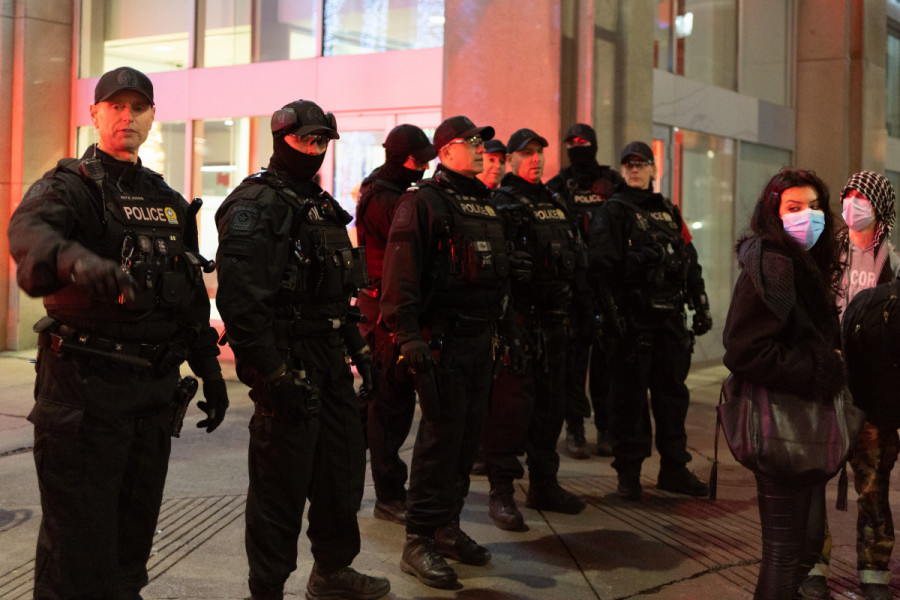
Around 40 students held a sit-in in the Henry F. Hall building mezzanine on Nov. 10 around 5 p.m. to protest austerity and the Concordia University administration’s recent ban on students tabling in the mezzanine. Students formed a barricade and erected several tents inside.
Stephanie Tremblay, a Concordia student and organizer of the demonstration who was granted a pseudonym for safety reasons, said students occupied the mezzanine in response to the tabling ban and as part of the province-wide week-long student strikes organized by the Coalition de résistance pour l’unité étudiante syndicale (CRUES) student union.
According to CRUES, student associations across Quebec representing over 100,000 students are participating in the strike, including three Concordia associations: the Women’s and Sexuality Studies Student Association, the School of Community and Public Affairs Student Association and the Linguistic Student Association.
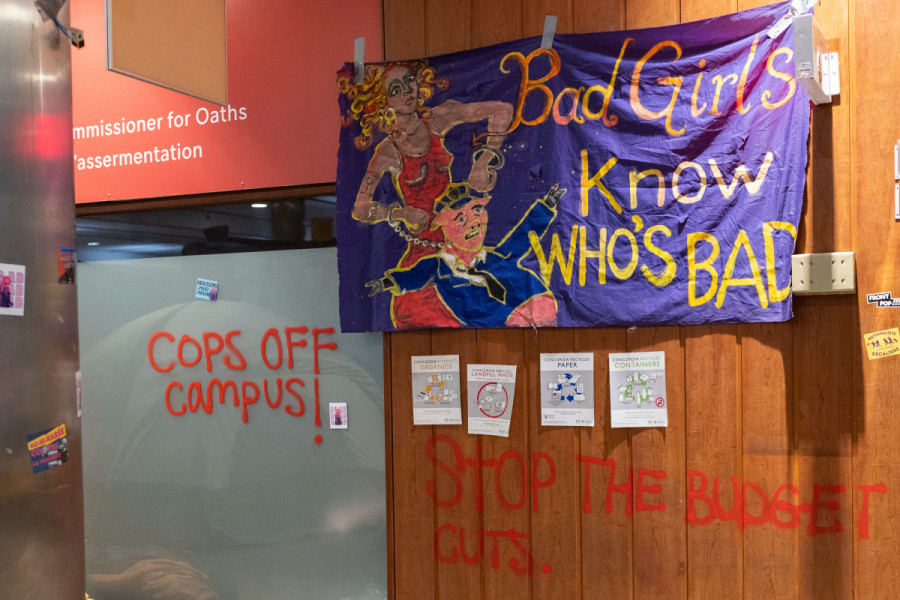
The demands include reform to the provincial Student Financial Assistance program and increased funding for educational institutions, infrastructure, staff and student housing at CEGEPs and universities across the province.
Tremblay pointed to crumbling infrastructure at schools such as Cégep de Saint-Laurent and the inaccessibility of financial aid for various groups of students, such as those who have received past parental support, international students and employed students.
“A lot of rules around it are very archaic and do not take into account the change [in] the cost of living,” Tremblay said.
Tremblay pointed to the decision not to renew the contracts of 63 limited-term appointment faculty members and various other austerity measures at Concordia.
“We feel the change in the quality of the education with classes being too full [and] overpacked, [and] teachers having more work to do because they have more classes to teach,” Tremblay said.
Concordia student Daniel Valcourt views the loss of mezzanine tabling as harmful to the campus community.
“We were given the space to talk about issues across the world,” Valcourt said. “It brought unity amongst students.”
Valcourt stated that the fact that Concordia President Graham Carr, who received $547,623 in 2024-25, is being paid more than Canadian Prime Minister Mark Carney is concerning to him, amid rising tuition and poor campus infrastructure conditions.
He feels that the administration is not listening to its students.
“This school should be a cooperative effort on the part of both the students and the administration to make it a space that is conducive to learning and to having community,” Valcourt explained.
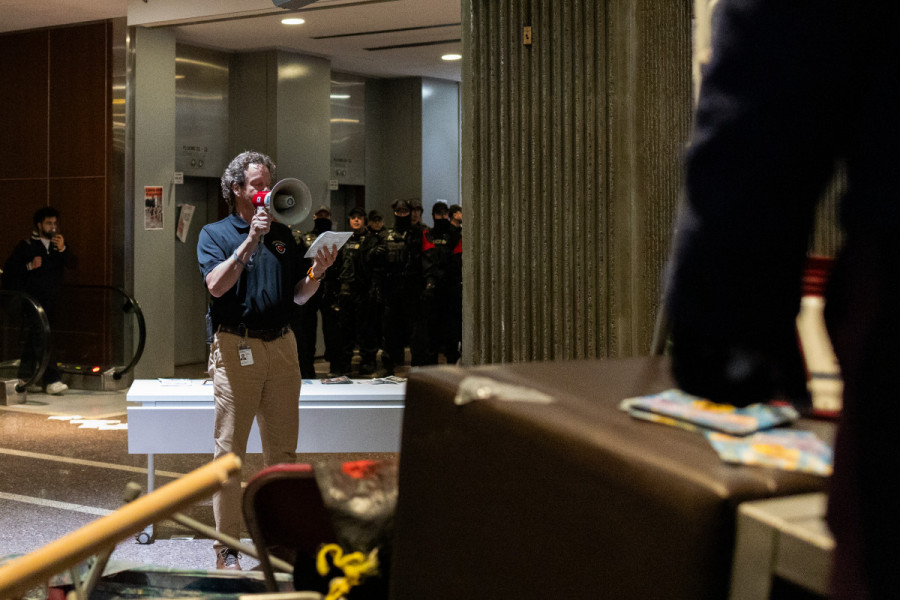
Around 8:50 p.m., Gilbert Dagenais, assistant director of Campus Safety and Prevention Services (CSPS), read an eviction notice to demonstrators. Riot officers from the Service de police de la Ville de Montréal (SPVM) and CSPS agents stood behind him.
One student played the Imperial March from Star Wars on a speaker as the officers approached. Seconds after the notice was read, riot police proceeded to enter the encampment and escorted student occupiers out of the building via an emergency exit.
A small group of evicted students began marching east on Sherbrooke St. towards McGill University. Shortly after 9 p.m., a large group of riot police charged into the crowd and began violently shoving the demonstrators, who dispersed soon afterward.
Tremblay said there were no warnings or interventions from CSPS between agents asking why the occupation was occurring and the issuing of the eviction notice.
She noted that students were not given time to collect their belongings or dismantle the tents before riot police moved in, and referred to the police intervention as “disproportionate” for a peaceful sit-in.
In a statement to The Link, Concordia spokesperson Vannina Maestracci said that CSPS and the SPVM were on the other side of a barricade masked individuals created using sofas, tables and chairs when they were read a notice of eviction.
“They all left immediately through the fire exit on the right side of the mezzanine that gives out on Bishop St. (inside the area they had barricaded),” Maestracci said. “Only one person who refused to leave was escorted out by the SPVM.”
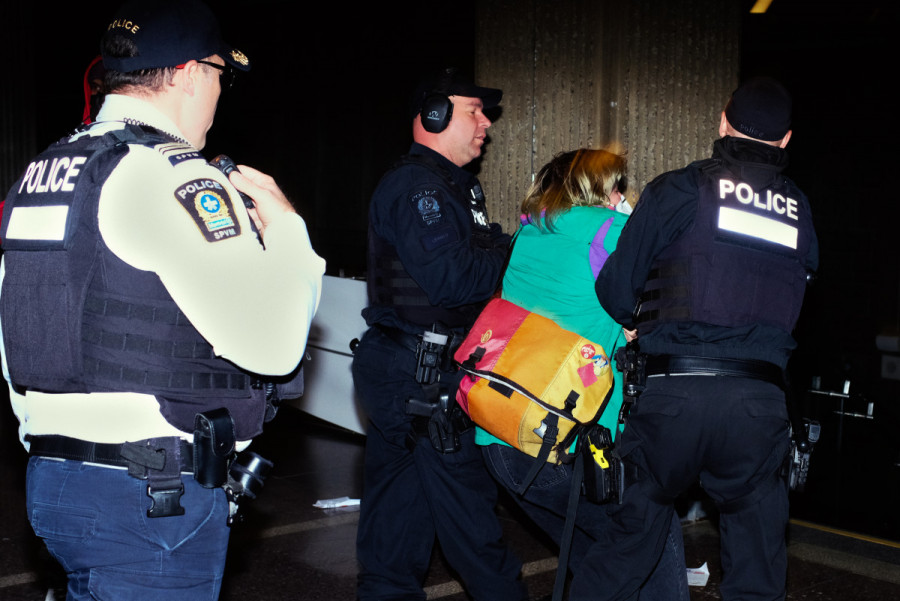
Cory Kuttner, a Concordia geography student who says they were present in the Hall building as a bystander, reported being physically removed by police.
“The cops started getting very pushy and aggressive with the other bystanders,” they said. “I was sort of shoved on the back by a cop while being asked to leave.”
Kuttner alleged that after they asked the SPVM officer not to touch them, a second officer approached them and the two officers forcefully dragged them out of the building.
A video provided to The Link by Kuttner shows two SPVM officers dragging Kuttner down the stairs and out of the building while Kuttner repeatedly shouts, “Don’t touch me!”
Kuttner stated that the incident resulted in a sprained ankle and psychological distress.
In response to questioning over their use of force, a representative of the SPVM told The Link they could not comment on specific police interventions. The SPVM also confirmed that no arrests or tickets were issued during the occupation.
Anna Sheftel, the principal of Concordia’s School of Community and Public Affairs, criticized the way CSPS agents treated students and faculty.
“I am blown away by the disdain with which CSPS agents treated faculty members and students who were observing, and by the fact that we had more police officers than protesting students on campus aggressively dismantling an entirely undisruptive protest,” Sheftel said.
Sheftel alleged that CSPS refused to answer her questions, treated her “unbelievably rudely” and escalated the situation by “ignoring or barking [orders] at students and profs who work and learn in the buildings they are paid to protect.”
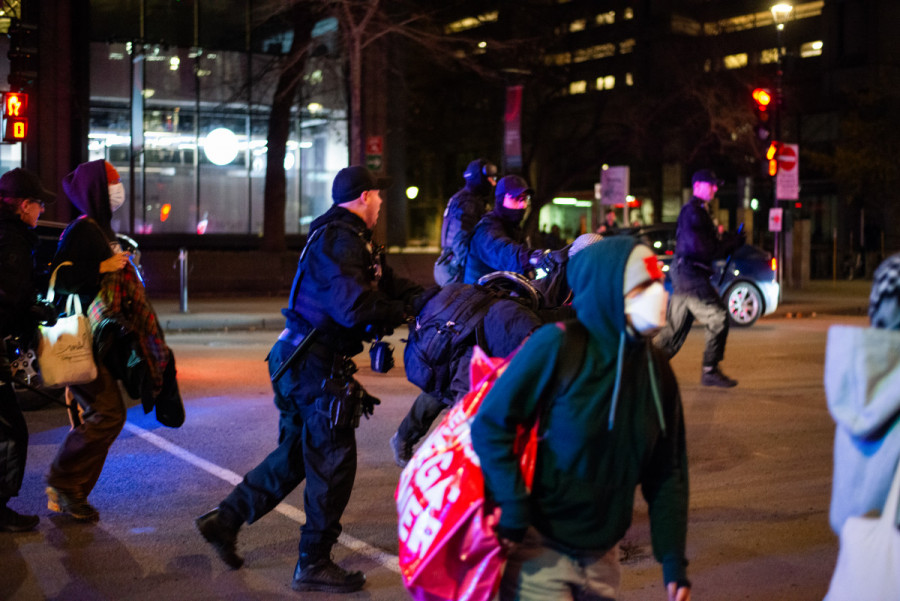
Sheftel also criticized the Concordia administration’s choice to call the police on students.
“When a university treats its students with this much disdain, putting them at serious risk for a protest that otherwise would have likely gone unnoticed, we have lost our way,” Sheftel said. “There is a world of interventions that exist between doing nothing and calling cops on non-violent students.”
Maestracci stated that the masked individuals refused to identify themselves to CSPS.
“Given this, it was impossible to establish if the individuals on the mezzanine were members of the Concordia community or external individuals, which would be an important security risk for our community,” Maestracci said.
Tremblay said she was unaware of CSPS asking demonstrators for identification. She expressed concern that identifying themselves could expose protesters to retaliation from the administration.
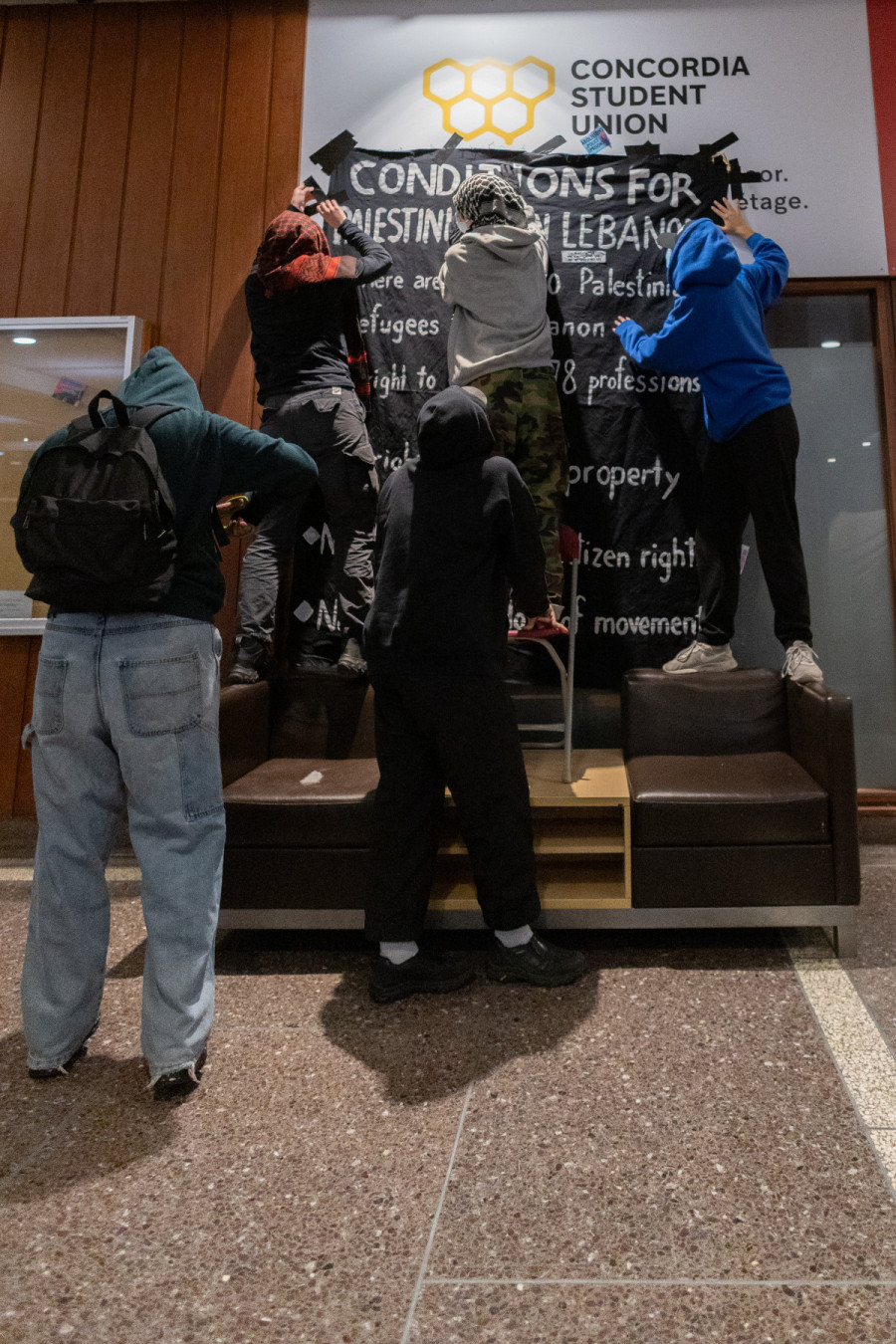
The Concordia Student Union (CSU) released a statement on Nov. 11 regarding the protest.
“The administration’s decision to facilitate the SPVM’s dismantlement of a peaceful occupation is a massive escalation that puts student safety at risk,” the statement reads.
The CSU alleges that the Concordia administration previously emailed them on Oct. 30 regarding unsanctioned use of the Hall mezzanine.
“The email threatened to prohibit the CSU from booking space on campus if we continued to table without permission,” the statement reads. “In prior communications, it was suggested that this could impact all groups under the CSU, including clubs.”
The CSU stated that the administration has accused them of being involved in unauthorized teach-ins on the Hall mezzanine on Nov. 9 and 10 and of involvement in the occupation.
The CSU denied these allegations, stating, “No CSU staff or Executives were present, participated in or planned the activities that transpired on the Mezzanine on the 9th and 10th of November.”